Why Does a Sofa Become Uncomfortable After a Few Years?
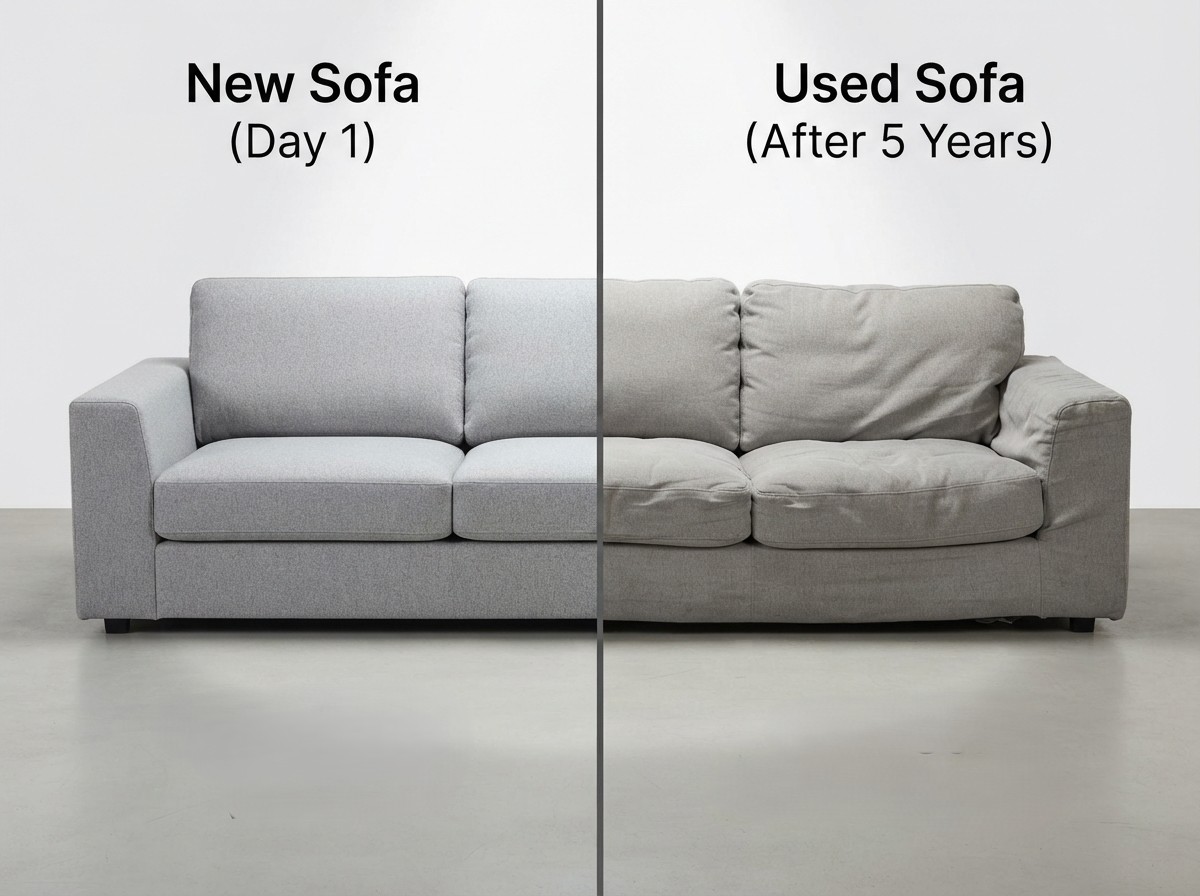
A sofa can feel perfect when you first buy it and still become uncomfortable a few years later. The cushions may start sinking in the middle, the seat may feel softer than it used to, and the back may no longer support you in the same way. Sometimes the fabric stretches or begins to lose its shape, making the whole sofa look and feel tired. This often leads people to conclude that the sofa simply did not have good quality. Sometimes that is true, but comfort changing over time is more complicated than that. A sofa is made up of several components that experience thousands of hours of sitting, leaning, getting up, children jumping on it, people sleeping on it, and everyday movement. Understanding what is inside a sofa can help you choose better in the first place and also understand whether a problem can actually be repaired later.
A Sofa Does Not Stay Exactly the Way It Felt on the First Day
One thing buyers sometimes expect is that a sofa should feel exactly the same five years later as it did in the showroom. That is not realistic. Most upholstered materials change to some degree with use. The important question is how much they change, how quickly they change, and whether the change is normal or excessive. A well-made sofa should age gradually. The cushions may soften slightly, the fabric may develop some signs of use, and the seating may become a little more relaxed. What you do not want is for the sofa to lose its support, develop deep permanent depressions, or become uncomfortable after only a short period of regular use. That difference is where construction and material selection become important.
What Actually Causes a Sofa to Become Uncomfortable?
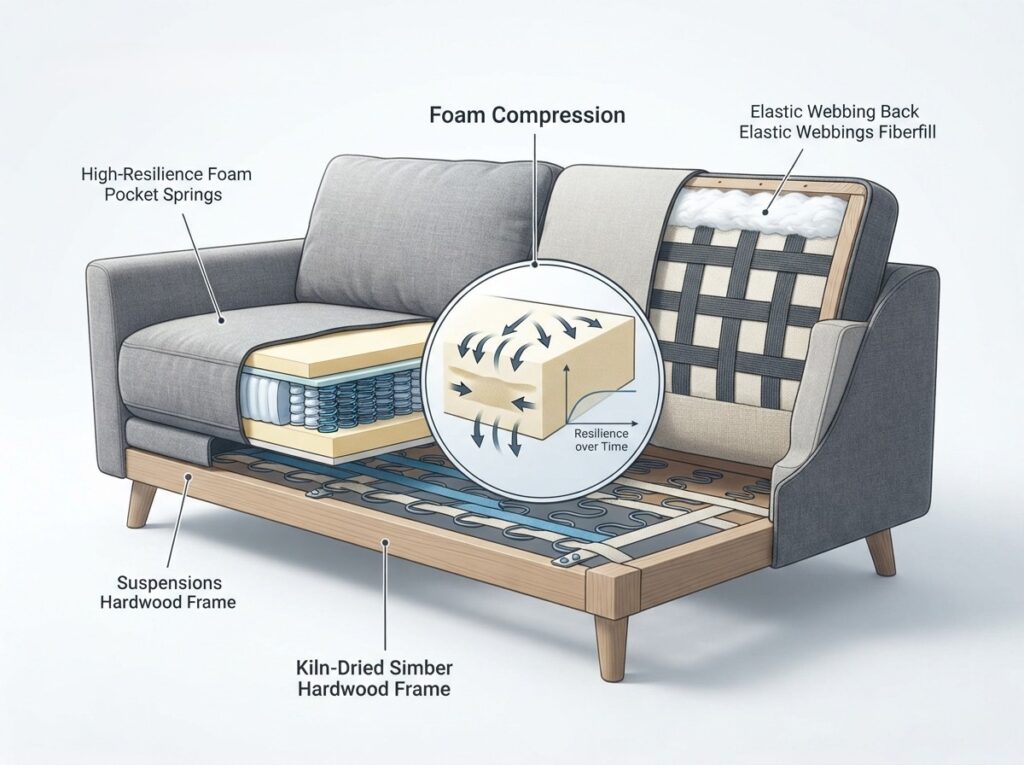
There is rarely one single reason. The comfort you experience when sitting on a sofa comes from several components working together.
| Component | What can change over time | What you may notice |
| Foam or cushioning | Compression and loss of resilience | Seat feels softer or sinks |
| Suspension | Can lose some of its original tension depending on construction and use | Less support and more sagging |
| Upholstery | Fabric or leather can stretch and change shape | Loose or wrinkled appearance |
| Frame | Movement or weakening can occur if construction is inadequate | Creaking, movement or uneven seating |
| Cushion shape | Filling can shift or compress unevenly | Lumps, depressions or uneven support |
| Sofa proportions | Your perception can change as the materials settle | Sitting position may feel different |
| Usage | High frequency or uneven use accelerates wear | One seat deteriorates faster than another |
The important point is that the cushion you sit on is only one part of the comfort system. Replacing the foam may solve the problem in one sofa, while in another, the real problem may be the suspension or the frame.
1. Foam Eventually Compresses
Foam is one of the most important contributors to how a sofa feels. When you sit down, your body compresses the foam, and when you get up, the foam is expected to recover much of its original shape. With repeated use, that process happens thousands of times. Over time, the foam can lose some of its resilience, and lower quality or unsuitable foam can deteriorate faster, particularly when it is being asked to support frequent daily use. This is why two sofas that feel equally comfortable in a showroom can perform very differently after several years. The important question is therefore not simply asking, “Is this sofa comfortable?”, but rather, “What is providing that comfort, and how is it expected to behave after years of use?”
2. Very Soft Does Not Always Mean Very Comfortable
This is one of the biggest misconceptions when shopping for custom made furniture bangalore. A very soft sofa can feel wonderful when you first sit on it, allowing you to immediately sink into it and giving you that relaxed feeling people often associate with comfort. But softness and support are not the same thing. If the cushioning compresses too much, your body can end up sitting deeper than intended, making getting up harder and maintaining a comfortable sitting position for a longer period difficult. On the other hand, an extremely firm sofa is not automatically better either. Good comfort comes from the relationship between firmness, resilience, support, seat depth, seat height, and back angle. This is why simply asking for “the softest foam” when planning a custom design sofa is not necessarily the right way to specify your seating.
3. The Suspension Underneath Also Matters
There is another part of the sofa that most customers never see. Under the cushions and upholstery, the sofa may use a particular suspension or support system whose job is to distribute the load and contribute to the overall sitting experience. If the suspension does not work well with the rest of the sofa, you can eventually notice excessive sagging or a change in the way the sofa supports your body. This is also one reason why judging a sofa only by its cushions can be misleading, as the cushion may be perfectly good while the support underneath it is not doing its job properly.
Good to know: When evaluating a sofa from premier furniture manufacturers in bangalore, ask what supports the seating underneath the cushion. You do not necessarily need to know every technical detail, but the manufacturer should be able to explain the construction clearly.
4. The Frame Affects Comfort Too
The wooden frame is usually discussed in terms of strength and durability, but it also affects how the sofa feels. Imagine sitting on a sofa where the frame has remained rigid and properly supported, but the cushioning has softened slightly; now imagine a sofa where the cushioning has softened and the underlying structure also has excessive movement. The two sofas will not feel the same, because a stable frame provides the foundation on which the other components work. This is one reason we believe it is useful for customers to understand the construction of their furniture rather than seeing only the finished product. With a ready-made sofa, most of the frame is already hidden by the time you see it in a showroom, but at Suhaus furniture manufactures in Bangalore—specializing in customised furniture—customers can see their own furniture while it is being made, observing the wooden frame, construction, and reinforcement before these parts disappear underneath the upholstery. That does not mean simply seeing a frame proves that a sofa will last forever; instead, it gives the customer something more useful: the ability to understand what is actually being built for them.
5. Uneven Use Can Make One Part of the Sofa Deteriorate Faster
Think about how a sofa is actually used in a home, where one person may always sit on the same side, another seat might barely be used, or someone may prefer lying down across the sofa every evening. After several years, these different usage patterns can create very different levels of wear, which is why you may sometimes see one seat looking noticeably more compressed than another. It does not automatically mean that the entire sofa was poorly made. However, if significant sagging appears across the sofa relatively quickly, it is worth investigating whether the cushioning, suspension, construction, or combination of materials is suitable for the intended usage.
6. Cushions Need Maintenance Too
Even a well-made sofa needs some basic care. If your sofa has loose seat or back cushions, regular repositioning can help distribute wear more evenly—for instance, if two seat cushions are interchangeable, periodically changing their positions can prevent one particular cushion from receiving almost all of the daily use. Depending on the construction, cushions may also need occasional reshaping, which is particularly relevant for softer cushions where the filling can shift or compress unevenly. The principle is simple: furniture that is used every day will benefit from occasional attention. That does not mean you should constantly maintain your sofa; rather, it means small habits can help slow down uneven wear.
7. Fabric Can Affect How the Sofa Feels Over Time
When people think about sofa durability, they often think about the frame and foam, but upholstery also changes the way a sofa feels. Fabric can stretch with use, and some materials develop more visible wrinkles or looseness than others while leather can also change character over time. If you are trying to weigh your options regarding tactile feel and longevity, it helps to read up on a leather sofa vs fabric sofa which is better comparison. A fabric becoming slightly relaxed is not necessarily a defect, but the bigger concern is when the upholstery loses its shape substantially, develops excessive sagging, or begins to separate from the underlying structure. This is another reason not to evaluate upholstery only by how attractive it looks in a showroom, but instead to ask how the material is expected to behave with regular use.
The Hidden Question: Can an Uncomfortable Sofa Be Fixed?
Often, yes. This is an important distinction between furniture that has aged and furniture that has become unusable. If the frame is structurally sound but the cushioning has deteriorated, replacing or refurbishing the cushions may significantly improve the sofa. If the upholstery has damaged but the underlying construction is still good, reupholstery may be possible. If the problem is deeper, such as a structural issue or suspension problem, the repair will need to address that particular component.
| Problem | Possible solution |
| Foam has become too soft | Replace or modify cushioning |
| Cushion has become uneven | Reshape, refill or replace depending on construction |
| Fabric is worn | Reupholster |
| Suspension has deteriorated | Repair or replace the relevant support |
| Frame has developed a structural problem | Assess and repair the frame |
| Several components have deteriorated | Refurbish multiple parts or consider replacement |
The key word here is possible. Not every sofa is economical to repair, and not every construction allows easy access to individual components, which is something worth asking before buying.
What Should You Ask Before Buying a Sofa?
Instead of asking only, “How long will this sofa last?”, ask more specific questions:
- About comfort: What cushioning is being used? How firm is it expected to feel after regular use? Can the seat depth or firmness be customised?
- About construction: What is supporting the seating? How is the frame constructed? What wood is used for the structural frame? Can I see the construction?
- About future maintenance: Can the cushions be replaced? Can the sofa be reupholstered? If something inside the sofa deteriorates, can it be repaired? Who will handle the repair?
These questions are much more useful than simply asking for a number such as “ten years”. Furniture does not have a single expiry date, and its lifespan depends on its construction, materials, usage, and how it is maintained.
One Thing Buyers Often Overlook: The Sofa Should Be Designed Around How You Actually Use It
A sofa for a formal living room that is used occasionally does not necessarily need the same specification as a sofa used by a family every evening. Similarly, a sofa that will be used for lounging, watching television, and occasionally sleeping on will experience different demands from one used mainly for sitting. When deciding between alternative setups, reviewing a detailed recliner sofa vs regular sofa which is best guide can also clarify what configuration fits your lifestyle. This is where investing in top-tier custom furniture becomes exceptionally useful. Rather than starting with a fixed product and trying to adapt yourself to it, you can specify dimensions, seat depth, firmness, and other details around how the sofa will actually be used. That does not mean custom is always better; if you are renting for a short period or simply want an inexpensive sofa for occasional use, spending significantly more on a bespoke piece may not make sense. The right specification depends entirely on the purpose.
What We Usually Recommend
When choosing a customised sofa, do not judge comfort only by what you feel during a five-minute showroom visit. Ask yourself what that comfort is likely to become after thousands of hours of use. Try different firmness levels, sit for long enough to understand the support, ask what materials are being used, understand the construction underneath the upholstery, and ask what can actually be repaired or replaced later. At Suhaus, as a premier destination for custom furniture, we encourage customers to be involved in the process because a sofa is not simply a finished object that appears in your living room. When a custom sofa is being made, there is a stage at which the frame, reinforcement, and construction are visible, allowing customers to see their own furniture at that stage rather than having to rely entirely on a finished showroom sample. That transparency is particularly useful when the parts that influence long-term comfort are eventually going to be hidden.
Common Mistakes When Buying a Sofa
- Choosing softness instead of support: A sofa that feels extremely soft in the showroom may not necessarily provide the best long-term comfort.
- Judging only the finished appearance: Beautiful fabric and polished wood tell you very little about what is happening underneath.
- Assuming a warranty guarantees a good experience: A warranty is a promise. The more important question is what actually happens when you need help—can the seller be reached, will someone inspect the problem, and can the relevant component be repaired or replaced? A written warranty can be useful, but it should not replace your assessment of the manufacturer and their ability to support the furniture after the sale.
- Never asking about repairability: People often spend significant time choosing the colour and design of a sofa but never ask whether the cushions, upholstery, or internal components can be repaired, which becomes important only when something eventually goes wrong.
A Simple Test Before You Buy
Before finalising a sofa, ask yourself these five questions:
| Question | Why it matters |
| Does it feel comfortable after sitting for several minutes? | First impressions of softness can be misleading |
| Do I understand what provides the support? | Comfort comes from more than the visible cushion |
| Do I know what is inside the frame and seating? | Hidden construction affects long term performance |
| Can important components be repaired or replaced? | Repairability can extend useful life |
| Do I trust the person making or selling it to support me later? | After sales service matters when problems appear |
If you can answer all five confidently, you are making a more informed decision than someone who simply chooses the sofa that feels softest in the showroom.
The Takeaway
A sofa does not become uncomfortable simply because it has become old. Usually, something has changed inside it: the cushioning may have compressed, the suspension may have lost some of its original support, the upholstery may have stretched, the frame may have developed movement, or several smaller changes may have added up over time. That is why long-term comfort starts with what you cannot see on the showroom floor. When buying a sofa, look beyond how it feels today. Understand what is underneath, how the sofa is constructed, how it is intended to be used, and whether the important components can be repaired later. And if you are investing in custom furniture, there is another useful advantage: you can sometimes see the construction before it disappears beneath the upholstery. The sofa you sit on today may feel great, but the better question is whether you understand why it feels great, and what is likely to happen after years of actually living with it.
Questions We Get Asked Often
1. Why does my sofa feel softer than when I bought it?
Regular use gradually changes cushioning materials. Some settling is normal, but excessive softening or permanent sagging can indicate that the cushioning or supporting construction is no longer performing as intended.
2. How often should sofa foam be replaced?
There is no universal replacement period. It depends on the type of foam, construction, frequency of use, and condition. If the sofa is uncomfortable or the cushioning has permanently lost its shape, it is better to assess the actual condition rather than replace it simply because a certain number of years have passed.
3. Does harder foam last longer?
Not necessarily. Foam firmness and durability are different properties. The right cushioning depends on the sofa design, intended use, and the comfort required.
4. Can an old sofa become comfortable again?
In many cases, yes. If the frame is sound, replacing cushioning, repairing the suspension, or reupholstering the sofa can give it another useful life. The right solution depends on what has actually deteriorated.
5. Is a very soft sofa bad for long term use?
Not automatically. Some people genuinely prefer softer seating. The concern is whether the sofa continues to provide adequate support as the cushioning settles with use.
6. How can I know whether a new sofa will stay comfortable?
You cannot predict it with absolute certainty, but you can improve your chances by understanding the cushioning, suspension, and frame construction, testing the sofa properly, and choosing a trusted expert who can explain how the furniture is made and what can be repaired later.