Solid Wood vs Veneer vs Engineered Wood: What Should You Actually Choose?
When buying wooden furniture, one of the first questions people ask is whether it is made from solid wood. It makes sense. You want to know what you are paying for, how long the furniture might last and whether it will still look good after years of use. But the conversation often becomes confusing. Solid Wood vs Veneer vs Engineered Wood is a classic debate where solid wood is treated as the obvious choice, veneer is assumed to be cheap or artificial, and engineered wood gets dismissed as something that will not last. The reality is more nuanced.
These materials are different, and each has its own uses. The right choice depends on the type of furniture, how it is constructed, how you plan to use it and what you expect from it. Whether you are browsing for general wooden furniture materials or commissioning custom wooden furniture, understanding the core differences matters. If you are buying a bed, dining table, wardrobe or sofa, here is what you should understand before making a decision.
First, what is the difference?
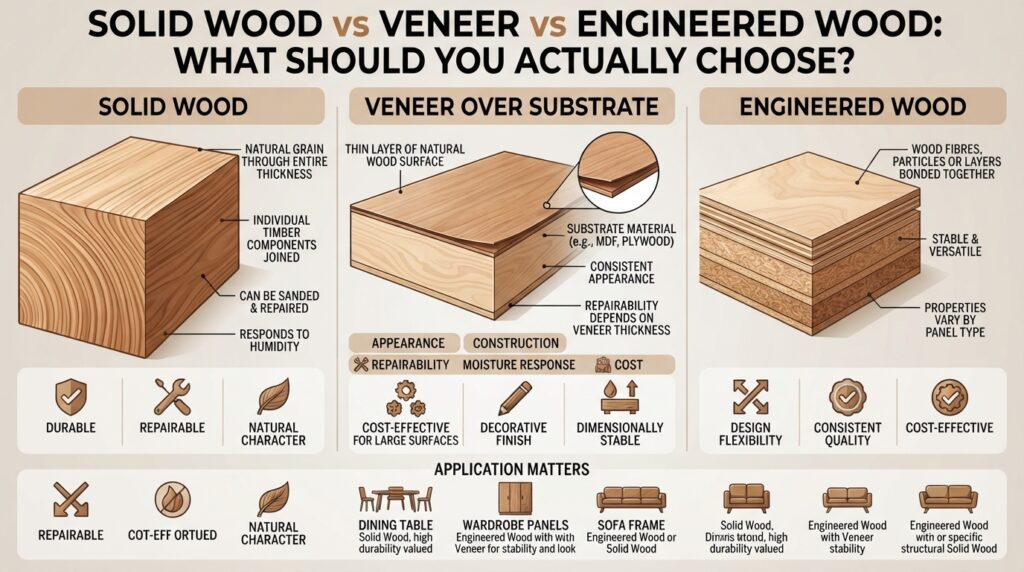
Solid wood is timber made from natural wood, rather than a panel formed by bonding wood fibres or layers together. Individual components may be cut and joined to make the furniture. Teak, rosewood, beech and ash are examples of woods used in furniture making.
Veneer is a thin layer of natural wood applied over another material, which may be plywood, MDF or another suitable substrate. It provides the appearance and grain of natural wood without requiring the entire component to be made from that species.
Engineered wood is a broad category of products made by bonding wood fibres, particles or layers together. It includes plywood, MDF and particleboard. These products are not interchangeable, and their properties depend on how they are made and where they are used.
One important distinction: veneer and engineered wood are not necessarily competing categories. A piece of furniture can have a veneer surface over an engineered wood panel. Understanding the complete construction matters more than knowing just one material name.
Solid wood vs veneer vs engineered wood
| Factor | Solid wood | Veneer over a suitable substrate | Engineered wood panels |
| Appearance | Natural grain and variations throughout the wood | Natural wood appearance on the surface | Depends on the panel and its finish |
| Construction | Individual timber components joined together | Thin wood layer bonded to a base material | Wood layers, fibres or particles bonded together |
| Repairability | Can often be sanded or repaired, depending on thickness and finish | Surface repairs depend on veneer thickness and damage | Depends on the panel, finish and type of damage |
| Moisture response | Moves naturally as humidity changes | Depends on the veneer, substrate and construction | Depends on panel type, quality and moisture exposure |
| Design flexibility | Suitable for many structural and decorative components | Useful for consistent wood appearances across broad surfaces | Useful for stable panels and particular shapes or applications |
| Cost | Varies with species, dimensions and workmanship | Varies with veneer species, substrate and finish | Varies with panel type, specification and finish |
There is no universal winner in this table. A well designed product uses materials appropriate to the job. A poorly constructed piece can disappoint regardless of which material is used.
When does solid wood make sense?
Solid wood is worth considering when you want natural wood throughout the relevant components, the ability to maintain or refinish suitable surfaces over time, and a material whose grain and character develop naturally. When investing in solid wood furniture, dining tables, wooden cots in bangalore, solid wood chairs and certain cabinet components are common examples where buyers may value these characteristics. Solid wood can also be shaped, joined and finished in different ways, giving furniture makers considerable flexibility.
However, solid wood is not maintenance free. It can expand and contract with changes in humidity, and its performance depends on seasoning, design, joinery and workmanship. A thick wooden component is not automatically well made simply because it is solid wood. The species also matters. Different woods have different properties, appearances and costs. Paying more for a particular species only makes sense if its characteristics suit the custom home furniture you are buying.
At Suhaus, solid wood is our primary material for wooden furniture. We also make selected pieces using plywood and veneer where the design calls for them. The important distinction is that the material is chosen for its intended application rather than treating every component as though it must use the same construction.
Is veneer a bad choice?
Not at all. Wood veneer is natural wood, just in a thin layer rather than throughout the component. One of its advantages is that it can provide the appearance of a particular wood across a large surface without using a full thickness of that timber. This can be useful for broad panels, decorative surfaces and designs that benefit from a consistent grain pattern.
The limitation is that the surface layer is thin. Deep scratches, chips or damage may be harder to repair than damage to a sufficiently thick solid wood surface. Repairability depends on the veneer thickness, the substrate and the type of finish. Veneer is therefore not automatically inferior to solid wood. It serves a different purpose. The important question is whether the overall construction suits the intended use and whether the seller clearly explains what is being used.
What about plywood, MDF and particleboard?
These materials are often grouped together under the umbrella of engineered wood, but they have different structures and properties. Plywood is made by bonding layers of wood veneer together, typically with the grain direction alternating between layers. It is used in many furniture applications because it can provide useful strength and dimensional stability when the appropriate grade and thickness are selected. MDF is made from wood fibres bonded together into a panel. Its relatively uniform surface can be useful for painted finishes and certain shaped components.
Particleboard is made from wood particles bonded together. Its performance depends on the panel specification, density, construction and protection from moisture. None of these descriptions alone tells you whether a particular piece of furniture is good or bad. The grade, thickness, manufacturing quality, edge treatment, hardware and exposure to moisture all matter.
At Suhaus, we do not use cheaper materials simply to reduce the material specification. Our selected use of plywood and veneer is based on the requirements of particular designs. That does not mean every furniture maker or every application needs to follow the same approach.
What should you choose for different types of furniture?
The most useful way to compare materials is to start with the component and its job.
| Furniture or component | What to consider |
| Dining table | Surface durability, construction, resistance to everyday wear and allowance for natural wood movement |
| Bed frame | Strength of the frame, joints, support structure and the materials used in load bearing components |
| Wardrobe | Panel quality, hardware, edge protection and exposure to moisture |
| Cabinet doors | Desired appearance, surface durability and whether the finish can be repaired |
| Decorative panels | Grain consistency, finish, design requirements and maintenance expectations |
| Sofa frame | Structural timber, joints, reinforcement and how the frame is assembled |
Notice that the material name is only one part of the decision. For example, a wardrobe panel and a sofa frame perform very different jobs. Comparing them only by whether they are made from solid wood misses the point.
Five questions to ask before buying
Before placing an order, ask the seller these questions.
1. Which material is used in each component?
Do not settle for a general answer such as wooden furniture. Ask whether the frame, panels, doors and visible surfaces use solid wood, veneer or engineered panels.
2. Which wood species is being used?
If the product is advertised as teak, ask whether the relevant component is actually teak or whether teak refers to the colour or finish.
3. What is the thickness and grade of the material?
This is particularly relevant for panels. The material name alone does not establish whether the specification is suitable.
4. How is the furniture constructed?
Ask about joints, support, hardware and how the product is assembled. The way materials work together affects the finished result.
5. What happens if something needs repair?
Ask whether damaged surfaces can be repaired, whether components can be replaced and what after sales support is available.
At Suhaus, as a trusted provider of customized furniture in bangalore, customers can visit the factory and see their own furniture while it is being made. Whether you are ordering custom dining tables or specialized bedroom sets, this provides an opportunity to understand the materials and construction before finishing or upholstery conceals the components. It is one practical way to ask more informed questions about what is going into your furniture.
The takeaway
Understanding Solid Wood vs Veneer vs Engineered Wood goes beyond looking at simple labels; these are different materials with different characteristics and applications. Solid wood may be the right choice when you value natural timber throughout the relevant components. Veneer can offer the appearance of natural wood with a different underlying construction. Engineered panels can be useful for applications where their particular properties suit the design.
The key is to understand what you are buying rather than relying on a label. Ask which materials are used, where they are used, how the furniture is constructed and what support you can expect over time. Good furniture buying starts with knowing what is inside the product, not just how it looks in the showroom.
Questions people often ask
1. Does solid wood always last longer than engineered wood?
Not automatically. Solid wood can be durable and repairable, but its performance depends on the species, preparation, construction and care. Engineered panels can also perform well when correctly specified and used in suitable conditions.
2. Is veneer real wood?
Yes. Veneer is a thin layer of natural wood bonded to a substrate. However, the presence of a real wood surface does not mean the entire component is made from that wood.
3. Is plywood better than MDF?
Neither is universally better. Plywood and MDF have different properties, and the appropriate choice depends on the application, required performance and product specification.
4. Is solid wood worth paying more for?
It can be, especially if you value natural wood throughout the relevant components, long term maintenance options and the particular characteristics of the species. Whether the extra cost makes sense depends on your budget, intended use and the construction offered.
5. How can I tell what material is used after furniture is polished?
Appearance alone is not a reliable way to establish the material. Ask for the specifications in writing and, where possible, inspect an unfinished sample or the relevant components during manufacturing.