Sofa Looks Perfect Online? Why it May Look Huge in Your Living Room
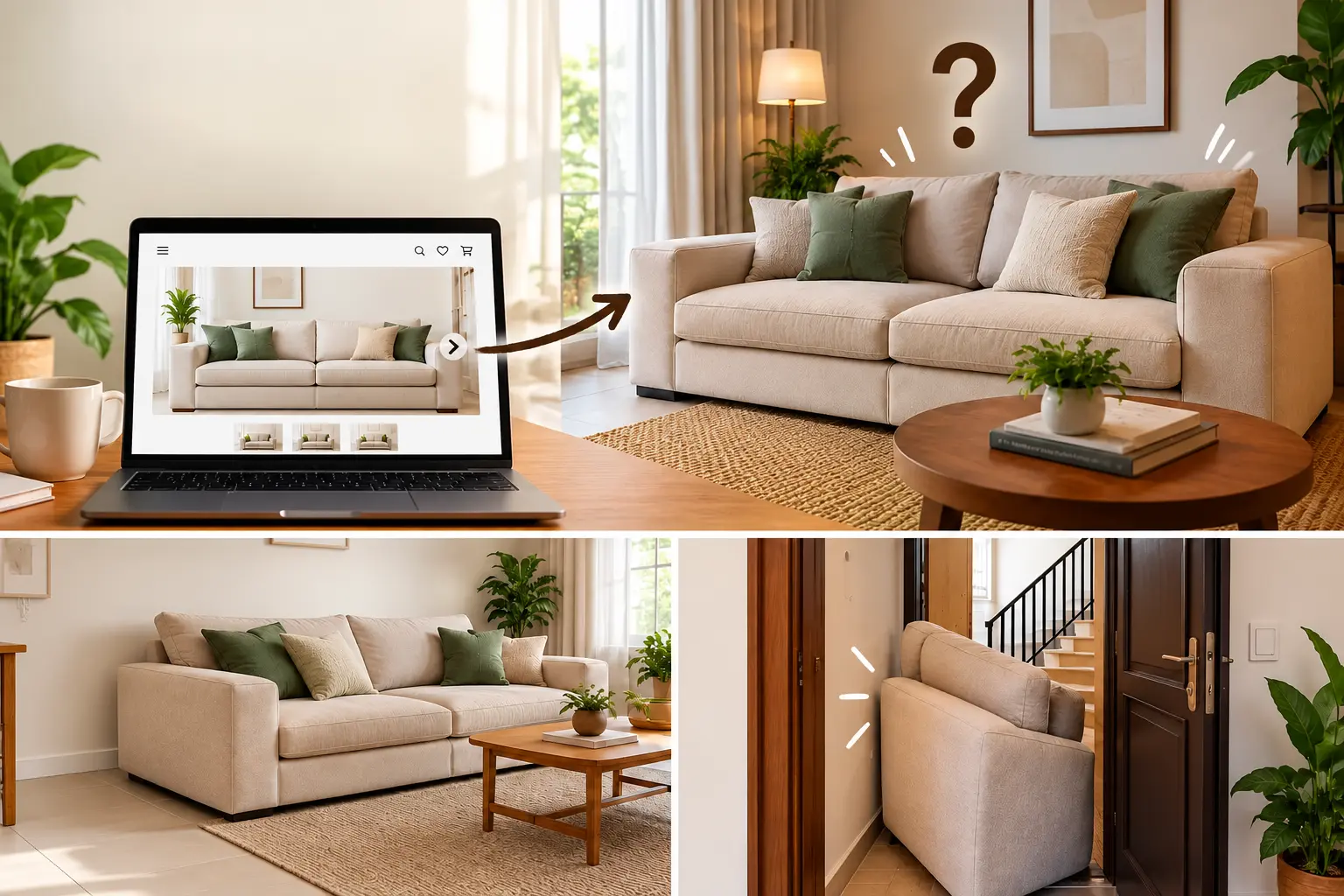
Have you ever seen a sofa online, loved its design, imagined it in your living room, and then realised it looked completely different once it arrived? When a sofa looks perfect online, it is easy to assume it will fit into your space just as seamlessly as it appears on screen.
This happens more often than people expect. Sometimes the sofa itself is perfectly fine. The problem is that the room is smaller than it appeared in the photograph, the sofa has deeper seats or broader arms than expected, or there simply isn’t enough space left to move around comfortably.
And sometimes, the problem goes beyond the room. The sofa may not fit through the main door, staircase or apartment lift, leaving the buyer with an expensive piece of furniture that cannot be brought inside.
These are not just problems with online furniture shopping. They happen whenever buyers choose furniture based on appearance without considering the actual space and practical constraints of their home. Before making a purchase, read our guide on 10 essential questions to ask before buying furniture.
Here is what to look at before placing that order.
1. Why Furniture Looks Smaller in Photographs
Furniture photographs are designed to show a product clearly. They rarely show you exactly how large it will feel inside your own living room.
There are a few reasons for this:
The room in the photograph may be much larger than yours:
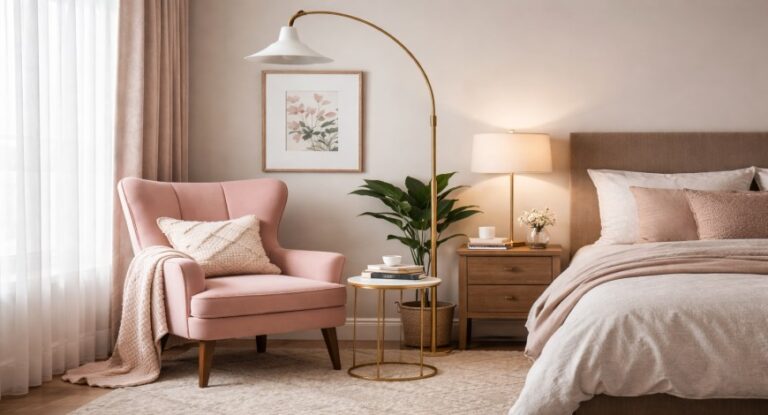
A sofa that looks perfectly proportioned in a spacious living room may dominate a compact apartment living room. You may see the sofa, a coffee table, a custom accent chair and decorative accessories arranged beautifully together. What you may not notice is how much space remains between these pieces, or how large the room actually is. Without knowing the room dimensions, it is difficult to judge whether the same arrangement will work at home.
Camera angles can change how furniture looks:
Wide angle photography can make a room appear more spacious. The camera position can also affect how large or small a sofa appears relative to the surrounding furniture.
A sofa photographed from a distance may look compact, even when it has a substantial depth and broad arms. This does not necessarily mean the seller is misrepresenting the product. It simply means a photograph is not a reliable substitute for actual measurements.
You cannot judge depth accurately from an image:
Width is usually the first measurement people check. Depth is often overlooked. For a complete guide on evaluating proportions and calculating clearances, see our article on how to choose the right sofa size for your living room. Checking full sofa measurements including depth and frame height—is essential before adding any piece to your cart.
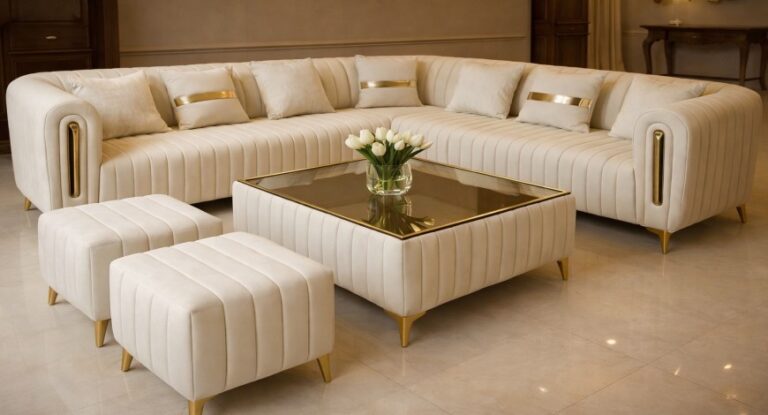
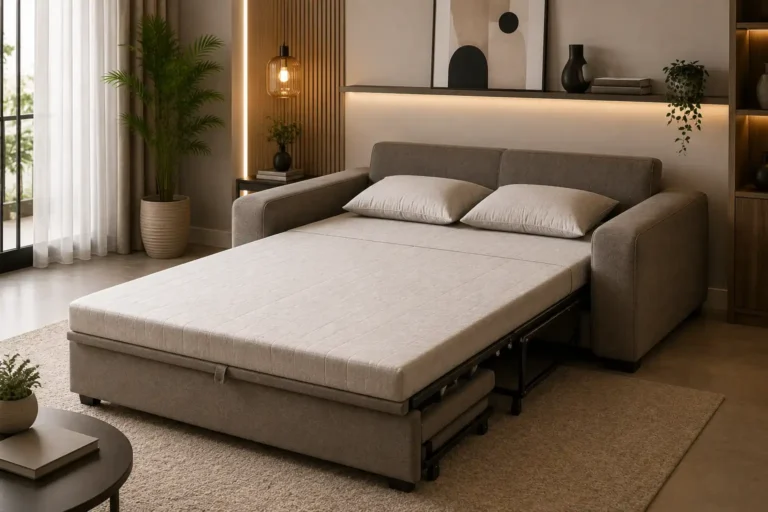
However, a deep sofa can extend much farther into the room than expected. A model with thick arms, a reclining mechanism or an extended chaise can occupy considerably more floor space than its front view suggests. A recliner sofa can also require extra clearance behind it when tilted back.
Two sofas with similar widths can therefore have very different effects on the room.
Expert tip: Never judge a sofa by its photograph alone. Check its overall width, depth and height, and compare those measurements with a sofa or piece of furniture you already have at home.
2. The Sofa Fits the Wall, But Does It Fit the Room?
One of the most common planning mistakes is checking whether a sofa fits along a wall without considering the rest of the room. Imagine a living room with a wall that is 9 feet long. You find a sofa that is 8 feet long and assume it will fit comfortably.
Technically, it fits along the wall. But what happens when you add the coffee table? Can someone walk past the sofa without turning sideways? Is there enough room to reach the balcony door? Can you pull out a drawer or extend a recliner?
These questions matter just as much as the sofa’s dimensions. Selecting the ideal sofa size for living room layouts means planning for circulation paths, not just wall lengths.
Furniture needs space not only for its physical footprint, but also for the activities that happen around it. To see how different pieces work together, read our guide on what types of living room furniture are commonly used.
Before choosing a custom sofa, consider:
- The space needed to walk past it.
- The distance between the sofa and coffee table.
- Access to doors, windows and balconies.
- Space needed to pull out storage or extend a recliner chair.
- The location of the television and other furniture like living room chairs.
- The number of people who regularly use the room.
A sofa that fits on paper may still make the room uncomfortable to use.
3. Why the Same Sofa Can Look Completely Different in Two Homes
Furniture does not exist in isolation. Its proportions affect how the entire room feels. A large, deep sofa may look balanced in a spacious living room with high ceilings and generous walkways. Place that same customized sofa set in a smaller apartment and it may make the room feel crowded.
The opposite can happen too. A small, delicate sofa may look lost in a large room. This is why choosing furniture by design alone can be misleading. Read our guide on which type of sofa is best for living room comfort and style to evaluate how different frame configurations suit varied floor plans.
Consider these examples:
| Furniture choice | What could go wrong | What to check |
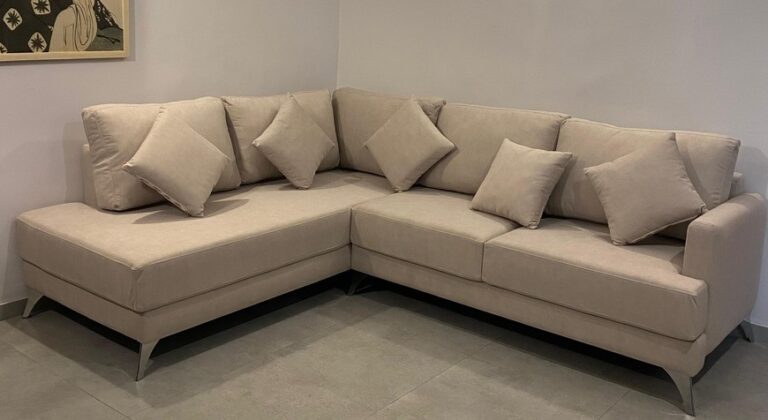
| Large L shaped sofa | The chaise blocks movement or occupies too much of the room | Both sides of the sofa and the remaining walking space |
| Deep three seater sofa | The sofa projects too far into the room | Overall depth and distance from nearby furniture |
| Sofa with broad arms | Less usable seating than expected | Overall width and actual seating width |
| Recliner sofa | The extended seat obstructs a passage | Space required when fully reclined |
| Oversized accent chair | The room feels crowded despite the chair being a single seat | Width, depth and surrounding clearance |
| Low, bulky sofa | The room feels visually heavier | Proportions relative to the room and other furniture |
The goal is not to buy the smallest sofa possible. It is to choose one that works with the room without compromising how you use it.
4. How to Visualise the Sofa Before Buying It
You do not need professional interior design software to get a reasonable idea of how a sofa will fit.
A few simple methods can prevent expensive mistakes.
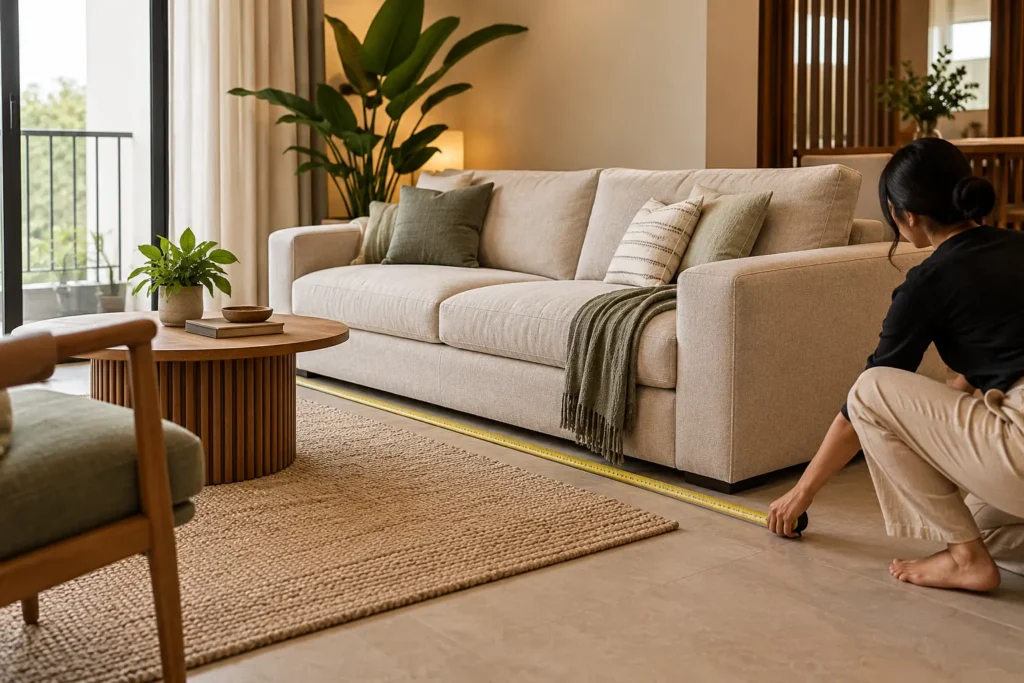
Method 1: Measure the room
Start by measuring the available area, not just the wall where the sofa will sit. Measure the width and depth of the space, including any sections that are restricted by doors, windows, pillars or passages.
Then measure the sofa using the dimensions provided by the manufacturer. Do not assume that a sofa’s listed width tells you everything you need to know. Check the depth, height and any extended dimensions too.
Method 2: Mark the sofa footprint on the floor
This is one of the easiest ways to understand the space a sofa will occupy. Use masking tape to mark its approximate width and depth on the floor. If you are considering an L shaped sofa, mark both sections.
Now walk around the marked area as you normally would. Try opening doors, walking towards the balcony, approaching the television and moving between the sofa and coffee table.
You may discover that the sofa fits but leaves less usable space than you expected. This exercise is particularly useful because it turns abstract measurements into something you can experience physically.
Method 3: Use cardboard or existing furniture
If you are still unsure, use cardboard boxes or other objects to approximate the sofa’s size and depth.
You could also rearrange your existing furniture temporarily to simulate the proposed layout. It will not reproduce the exact shape or comfort of the new sofa, but it can help you understand how much floor space will remain.
Method 4: Create a simple floor plan
For more complicated layouts, draw the room on paper with approximate dimensions. Mark the doors, windows, passages and existing furniture. Then draw the proposed sofa to scale.
This is particularly useful when comparing a straight sofa with an L shaped design, or when deciding whether two smaller seating pieces or accent chairs bangalore options would work better than one large sofa.
For compact layouts, explore our guide on space-saving furniture options for small apartments in bangalore. The important thing is to plan the entire arrangement rather than considering each piece separately.
5. Do Not Forget the Space Needed to Move Around
A living room can look well arranged in a photograph and still be inconvenient in everyday use.
For example, you might squeeze a large sofa, coffee table and two accent chairs into a room. Everything fits, but people have to navigate around furniture to reach the balcony or enter the room.
That is not a successful layout. As a starting point, many living rooms benefit from roughly 75 to 90 cm of clear walking space along main routes. The ideal clearance depends on the layout, door swings, household needs and how frequently that route is used. More space may be necessary for comfortable movement in busy areas.
Similarly, the distance between a sofa and coffee table should allow people to reach the table without struggling to stand up or walk past. These are planning guidelines, not rigid rules. The key is to identify the routes people use every day and avoid blocking them.
A useful test: Imagine carrying a cup of coffee from the kitchen to the sofa. If the layout makes that simple task awkward, reconsider the arrangement before you buy sofa in bangalore.
6. When the Design You Like Does Not Work in Your Space
Sometimes the problem is not the size of the sofa alone. It is the design itself. You might love a large curved sofa, a wide L shaped configuration or a sofa with a deep chaise. But the room may not have enough space to accommodate it without restricting movement.
This does not automatically mean you need to abandon the design. You may be able to adapt it.
For example:
- Choose a shorter sofa with similar styling.
- Reduce the depth while keeping proportions appropriate for the design.
- Select a straight sofa instead of an L shaped configuration.
- Use a separate accent chair design rather than extending the sofa.
- Consider a different arm design to reduce the overall width.
- Explore a custom size that suits the room more closely from a sofa manufacturer in bangalore.
Customisation can be useful when you have a clear idea of what you want but standard dimensions do not work. If you are comparing ready-made versus bespoke options, check our guide on custom wooden sofa design vs ready-made.
However, not every design can be reduced indefinitely without affecting its proportions, comfort or construction. Some designs need a minimum amount of space to work properly. The right approach is to discuss the constraints with a designer sofa maker in bangalore before committing to the design.
7. The Other Problem: Will the Sofa Even Get Inside Your Home?
This is a particularly important consideration in apartments. You may have measured the living room correctly, chosen the right sofa dimensions and planned the layout carefully. Yet the sofa may still be impossible to bring inside.
Small apartment lifts, narrow staircases, tight landings, entrance doors and sharp turns can all create access problems. A sofa that fits inside the living room is not necessarily a sofa that can reach it.
Buyers sometimes discover this only after the furniture has been manufactured and delivered. If the product cannot be brought inside, they may be left trying to negotiate a return, modification or alternative delivery arrangement. The consequences can be expensive, especially when the full payment has already been made.
Before placing an order, ask the manufacturer whether the sofa can be delivered in separate sections, whether its legs or other parts can be removed, and whether it can be assembled inside the home.
Also measure the narrowest points along the delivery route, not just the main doorway. For a detailed guide to measuring doors, lifts and staircases before ordering, see our upcoming article on whether your sofa will fit through the door. Do not leave access measurements until delivery day. Confirm the delivery route before finalising the order.
8. Can Custom Furniture Help Prevent These Problems?
It can, provided the customisation is planned properly. With ready made furniture, you generally choose from the dimensions and configurations available. That works well when a standard model fits your room and can be delivered without difficulty.
With made to order furniture, there may be more flexibility to adjust dimensions, seating configurations, materials and certain design details. Working with tailored custom sofa dimensions allows you to alter overall width, seat depth, and modular sectioning to match your exact spatial and delivery requirements.
For example, a customised sofa in bangalore can sometimes be made shorter to fit a wall, shallower to preserve a passage or divided into sections to make apartment delivery easier.
At Suhaus, a trusted furniture manufacturing company in bangalore, customers can discuss their room dimensions, preferred design and practical requirements when planning custom furniture. Visiting the studio also allows them to compare different proportions, finishes and seating configurations rather than relying entirely on photographs. To understand structural quality during a workshop visit, read our guide on how to know what is inside a sofa before you buy it.
However, custom furniture is not a substitute for proper measurement. As experienced custom furniture makers bangalore homeowners rely on, our team needs accurate information about the room and delivery access to recommend suitable dimensions. .
Custom furniture works best when the design, room and delivery constraints are considered together, before manufacturing begins.
Before You Order a Sofa: A Practical Checklist
Use this checklist before confirming your purchase.
Room and layout
- Have I measured the available space?
- Have I checked the sofa’s overall width, depth and height?
- Have I accounted for the coffee table and other furniture?
- Can people move comfortably around the room?
- Will doors, windows and passages remain accessible?
Comfort and design
- Is the seat depth suitable for how I sit?
- Are the arms and back proportions appropriate for my room?
- Will the design work without making the space feel crowded?
- Can the dimensions or configuration be adjusted if necessary?
Delivery and access
- Will the sofa fit through the entrance door?
- Can it pass through the apartment lift or staircase?
- Are there tight corners or narrow landings?
- Can the sofa be dismantled or delivered in sections?
- Have I confirmed the delivery plan with the sofa makers in bangalore?
Order and payment
- Are the final dimensions recorded in writing?
- Have I discussed what happens if delivery access proves difficult?
- Are the delivery, installation and modification terms clear?
- Do I understand the payment and cancellation terms?
- Have I evaluated pricing value correctly? See our guide on how to compare furniture prices without comparing only the price.
These checks take a little time, but they are considerably easier to complete before manufacturing than after the sofa arrives.
The Takeaway
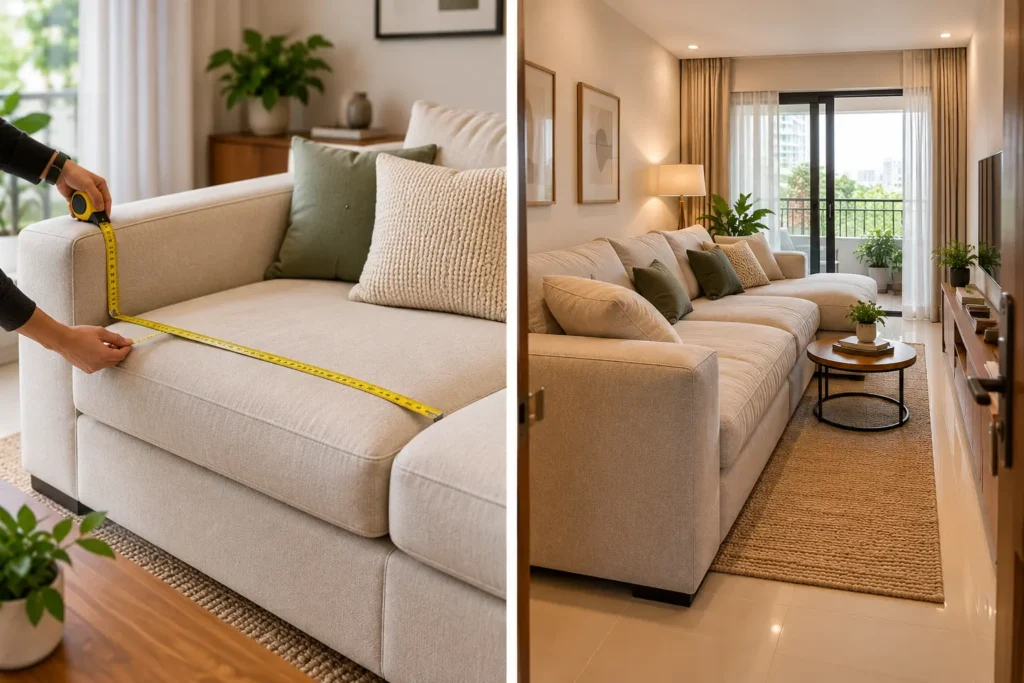
A sofa can look perfect online and still be the wrong choice for your home. The problem may be its size, depth, proportions, configuration or the amount of space it leaves for everyday movement. In apartment buildings, there is another practical consideration: whether the sofa can physically reach the room.
Before ordering, measure the room, visualise the sofa footprint, check the walking routes and confirm delivery access.If a design you like does not fit, explore whether its dimensions or configuration can be adapted by a customized home furniture manufacturer in bangalore.
Do not wait until delivery day to discover a problem that could have been identified before placing the order.
The right sofa is not simply one that fits your living room. It is one that fits your life in that room.
Frequently Asked Questions
1. Why does a sofa look smaller online than it does at home?
Photographs can distort our perception of size because of camera angles, room proportions, perspective and the surrounding furniture. Always compare the sofa’s actual dimensions with your available space.
2. How do I know whether a sofa is too big for my living room?
Measure the proposed sofa footprint and mark it on the floor. Then assess the walking routes, distance from nearby furniture and access to doors and windows. If the arrangement restricts normal movement, consider a smaller size or a different configuration.
3. Can I buy an L shaped sofa for a small living room?
Yes, if the dimensions and layout work. Check both sections of the sofa, the chaise depth and the space left for movement. A compact straight sofa with an accent chair may sometimes provide a more flexible arrangement.
4. What should I do if my sofa cannot fit through my apartment lift?
Contact the manufacturer before delivery and ask whether the sofa can be separated into smaller sections or assembled inside the apartment. Whether this is possible depends on the sofa’s construction and design, so it should be confirmed before the order is finalised.
5. Is custom furniture better for small apartments?
It can be useful when standard dimensions do not suit the room, but it is not always necessary. If a ready made product fits your space, meets your needs and can be delivered safely, there may be little benefit in customising it.
6. Should I buy a sofa based on the room dimensions alone?
No. The room dimensions are only one part of the decision. You must also consider circulation space, comfort, the other furniture in the room and the route through which the sofa will be delivered.