What Is Sofa Foam Density? How to Check Quality, Types and Questions to Ask
When buying a sofa, most people pay attention to the fabric, colour, design and how comfortable it feels when they sit on it. But what makes a sofa comfortable after months or years of regular use?
One important factor is the foam used inside the cushions. Two sofas may look almost identical from the outside but feel very different after extended use. One may retain its shape and support, while the other may develop noticeable sagging or become uncomfortable after a few years. This is where understanding sofa foam density becomes useful.Foam density is one of the factors that influence how well a sofa cushion maintains its structure over time. However, higher density does not automatically mean better comfort, and density alone cannot tell you everything about sofa foam quality. To learn more about the internal components that support cushioning, read our guide on what is inside a sofa.
Let’s understand what foam density means, the different sofa foam types and what you should check before buying a sofa. When choosing a custom made sofa, understanding the foam specifications can help you make a more informed decision about comfort and durability.
What Is Sofa Foam Density?
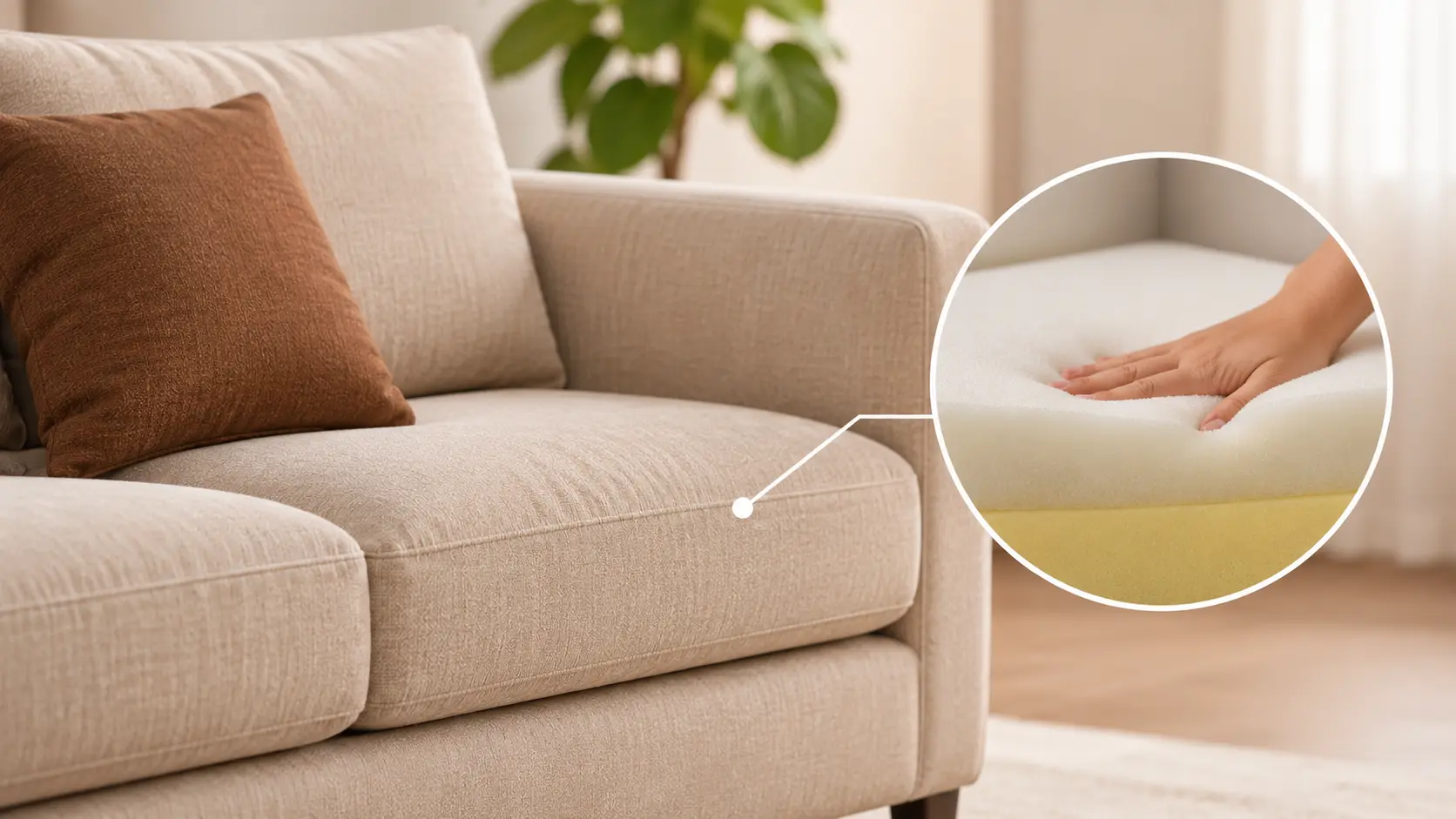
Sofa foam density refers to the mass of foam contained in a given volume. It is commonly expressed in kilograms per cubic metre (kg/m³).For example, foam with a density of 32 kg/m³ means that one cubic metre of that foam weighs approximately 32 kilograms.
You may hear furniture manufacturers refer to 28-density, 32-density or 40-density foam. These numbers generally indicate the foam’s density in kg/m³.Density is important because it can influence a foam’s durability and ability to maintain its performance over time.
However, foam density should not be confused with firmness.A high-density foam can be manufactured to feel relatively soft, while a lower-density foam can feel firm.The actual sitting experience depends on the foam’s formulation, firmness, thickness and cushion construction.
Does Higher Foam Density Mean Better Sofa Quality?
Not necessarily. Higher foam density can be associated with better durability, particularly when comparing similar types of conventional polyurethane foam.However, density is only one part of sofa foam quality.
For example, a 40-density foam is not automatically more comfortable than a 32-density foam. It may offer different performance characteristics depending on its formulation.Similarly, a sofa with very firm foam may feel supportive initially but may not suit someone who prefers a softer sitting experience.
When evaluating foam, consider three separate characteristics:
- Density: The amount of foam mass within a given volume.
- Firmness: How much resistance the foam offers when compressed.
- Resilience: How effectively the foam responds and recovers after pressure is applied.
A good sofa cushion should offer a suitable combination of these properties.The goal is not simply to choose the highest density available, but to select foam that matches the intended comfort and usage requirements.
What Is the Best Foam Density for a Sofa?
The best foam density for sofa seating depends on how frequently the sofa will be used, the foam type and the comfort level you prefer.For conventional flexible polyurethane foam, the following ranges can serve as general reference points.
| Foam Density | General Consideration | Typical Suitability |
| Below 25 kg/m³ | Lower-density foam; performance depends on grade | Light-use applications and certain cushioning layers |
| 25–30 kg/m³ | Moderate-density range | Backrests and some seating applications |
| 30–35 kg/m³ | Common range for regular-use seating | Everyday sofa seat cushions |
| 35–40 kg/m³ | Higher-density range | Frequently used seating where durability is a priority |
| Above 40 kg/m³ | Higher material density | Selected premium or specialized cushion constructions |
These ranges are indicative, not universal quality standards. Different foam technologies cannot always be compared directly using density alone.For a regularly used sofa, foam around 30–40 kg/m³ may be worth considering, provided its firmness, resilience and durability are appropriate.The best choice should be based on the complete cushion construction rather than a density number alone.

What Are the Different Types of Sofa Foam?
Furniture manufacturers use different foam materials depending on the sofa’s design, comfort requirements and intended use.Understanding the common sofa foam types can help you ask more informed questions.
1. Conventional Polyurethane Foam
Polyurethane foam, often called PU foam, is widely used in upholstered furniture.It is available in different densities and firmness levels, making it suitable for various cushioning applications.
Depending on its grade, PU foam may be used in seat cushions, backrests, armrests and other upholstered sections.Its performance depends on the foam formulation and manufacturing quality, not simply its density.
2. High Resilience Foam
High Resilience (HR) foam is designed to offer responsive support and good recovery after compression.It is often considered for seating applications where comfort and repeated-use performance are important.
HR foam can provide a supportive feel while allowing the cushion to respond to body movement.However, not every product marketed as HR foam has identical properties. Ask the manufacturer about the specific grade and performance characteristics.
3. Memory Foam
Memory foam is designed to respond gradually to pressure and body heat, allowing it to conform to the body.It is commonly associated with mattresses but may also be used in certain sofa cushioning arrangements.Memory foam is generally slower to recover than conventional or HR foam.For this reason, it is often used as a comfort layer rather than the sole structural support in a sofa seat.
4. Rebonded Foam
Rebonded foam is made by combining pieces of foam under compression using a bonding process.It is often relatively dense and firm, depending on its composition.It may be used in selected support applications, but high density does not automatically make it the best choice for a comfortable sofa seat.The suitability depends on the overall cushion design and the type of support required.
Make your space unique with Suhaus custom furniture, designed to match your style and needs.
Explore Our SofasHigh Density Foam Sofa vs Regular Foam Sofa
When comparing a high density foam sofa with one using lower-density foam, it is important to look beyond the initial sitting experience.
| Factor | Higher-Density Foam | Lower-Density Foam |
| Material density | More foam mass per unit volume | Less foam mass per unit volume |
| Durability | Often better within comparable foam grades | May wear faster under similar conditions |
| Firmness | Can be soft, medium or firm | Can also be soft, medium or firm |
| Comfort | Depends on formulation and cushion design | Depends on formulation and cushion design |
| Cost | May be more expensive | Often more economical |
| Suitability | Worth considering for frequent-use seating | May suit lighter-use or selected cushioning applications |
Higher density can be beneficial, but it should not be treated as a guarantee of long-lasting comfort.
How Can You Check Sofa Foam Quality Before Buying?
Most sofa cushions are covered with leather or fabric upholstery, making it difficult to judge the foam visually. However, there are several practical ways to evaluate sofa foam quality.
1. Sit on the Sofa for More Than a Few Seconds
A quick sitting test may not reveal much about comfort.Spend a few minutes sitting in your normal position. Check whether the cushion provides adequate support and whether you feel excessive pressure beneath your thighs or hips.If possible, try different seating positions.
2. Observe How the Cushion Recovers
Press the cushion with your hand and release it.Notice whether it returns to its original shape.A cushion that recovers consistently may indicate suitable resilience, although this simple test cannot establish its long-term durability.
3. Ask for the Foam Density
Ask the manufacturer about the foam density used in the seat cushions.Do not assume that the same foam is used throughout the sofa.Seat cushions, backrests and armrests may use different foam grades to achieve the required comfort and shape.
4. Check the Cushion Construction
A sofa cushion may contain more than one layer of foam.For example, a firmer support layer may be combined with a softer comfort layer.Ask whether the cushion uses a single foam grade or a layered construction.This helps you understand why two sofas with similar stated densities may feel different.
5. Understand the Warranty
Ask whether the warranty covers foam-related concerns and what conditions apply.Some warranties may cover specific manufacturing defects but exclude normal softening or changes caused by regular use.Understanding these terms before buying can prevent misunderstandings later.
Why Do Sofa Cushions Sag Over Time?
Sofa cushions experience repeated compression whenever someone sits on them.Over time, foam may gradually lose some of its original firmness or ability to recover.The rate of change depends on several factors, including foam quality, frequency of use, cushion thickness and the weight placed on it. Understanding why sofa fabric peels or sags also helps you spot exterior wear early. However, foam is not always the only reason a sofa develops sagging.
The support structure beneath the cushions, such as webbing, springs or other suspension components, can also influence how the seating feels. Learn how frame construction and webbing affect longevity in our guide on durable furniture construction.If a sofa begins to sag, it is important to identify whether the problem comes from the foam, cushion construction or underlying support system before deciding on a repair.
Questions to Ask Before Choosing Sofa Foam
Before finalising your sofa, consider these important furniture buying questions to make the right choice.
- What type of foam is used in the seat cushions?
- What is the foam density in kg/m³?
- Is the foam conventional PU, HR or another type?
- Are different foam grades used for the seats and backrests?
- How is the cushion designed to provide both comfort and support?
- What foam-related concerns are covered under the warranty?
- Can the cushion firmness be customized according to my preference?
These questions can help you understand what you are purchasing rather than relying only on descriptions such as premium foam or high-density cushioning.
At Suhaus, we believe that understanding the materials inside a sofa is just as important as choosing its external design. When selecting custom made furniture, discussing seating comfort, foam specifications and construction details can help ensure the finished sofa suits your requirements. If you are planning a custom design sofa, discuss your preferred seating firmness, foam density and cushion construction with the manufacturer.
Final Takeaway
Sofa foam density is an important factor to consider when buying a sofa, but it should never be the only deciding factor.Higher-density foam may offer durability advantages within comparable foam types, while firmness and resilience influence how the sofa actually feels.For everyday seating, consider the foam type, density, cushion construction and comfort together.
Most importantly, ask the manufacturer about the materials used inside the sofa rather than judging quality only by its appearance or initial softness. Choosing custom furniture also gives you the opportunity to discuss materials, cushioning and comfort requirements based on your preferences. A comfortable sofa should not just feel good on the day you buy it. It should provide suitable support throughout its intended years of use.
Make your space unique with Suhaus custom furniture, designed to match your style and needs.
Explore Our SofasFrequently Asked Questions
1. What is the best foam density for a sofa?
For conventional polyurethane foam used in everyday sofa seating, approximately 30–40 kg/m³ is a useful range to consider. However, the best density depends on foam type, firmness, cushion construction and usage requirements.
2. Is 32-density foam good for a sofa?
A good-quality 32 kg/m³ foam can be suitable for regular sofa seating. Its performance also depends on firmness, resilience, thickness and the quality of the supporting structure.
3. Does high-density foam mean a hard sofa?
No. Density and firmness are different properties. High-density foam can be manufactured with varying levels of softness or firmness depending on its formulation.
4. What is the difference between PU foam and HR foam?
PU foam is a broad category of polyurethane cushioning materials. HR foam is a type of polyurethane foam engineered for greater resilience and responsive support. Performance varies according to the specific grade.
5. How can I tell if my sofa has good-quality foam?
Ask for the foam type, density and manufacturer specifications. Test the seating comfort, observe cushion recovery and understand the warranty terms. A brief sitting test alone cannot reliably determine long-term foam durability.