Can You Really Tell What Wood Is Used After Furniture Is Polished?
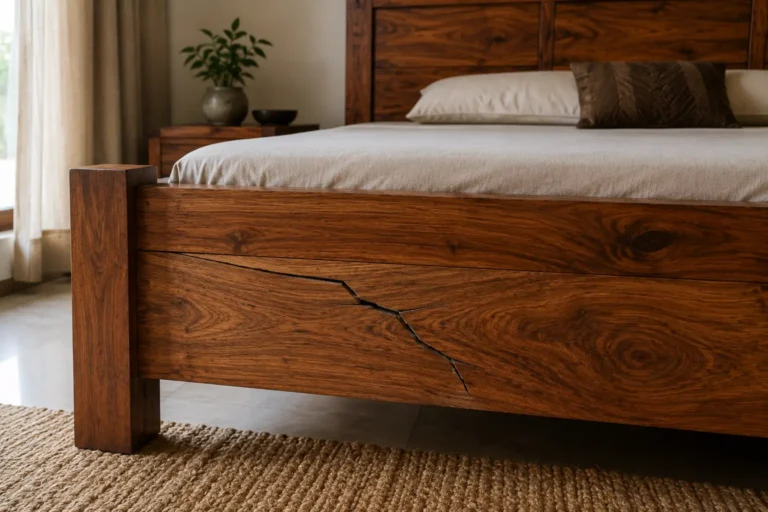
You visit a furniture showroom and find a beautiful wooden cot. The seller tells you it is made from teak wood. The colour looks right, the finish is smooth, and the furniture feels solid. You have no particular reason to doubt the claim, so you proceed with the purchase.But here is the problem. Once wood is polished, stained or covered with a coloured finish, it can become much harder for an ordinary buyer to identify the actual wood underneath. When you want to check wood before buying furniture, appearance alone can easily mislead you.
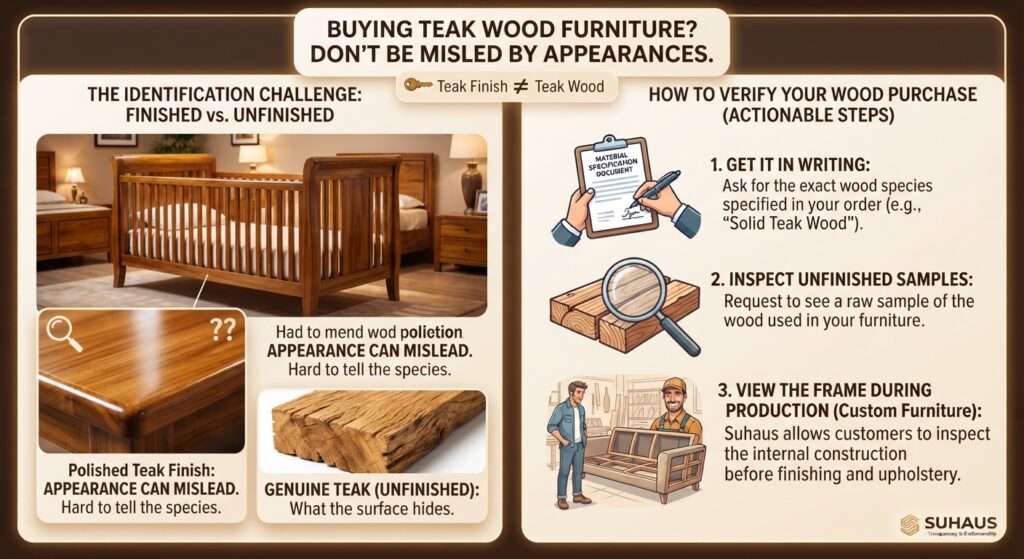
A piece of furniture that looks like teak is not necessarily made from teak. Terms such as teak finish, teak colour and teak polish can describe the appearance of the furniture rather than the species of wood used to make it. This does not automatically mean the seller is misleading you. Different woods can be finished to achieve similar appearances, and a particular finish may be chosen for perfectly legitimate design reasons.
The important distinction is between what the furniture looks like and what it is actually made from. If you are paying for a particular wood species, you should know how to verify that claim rather than relying entirely on the colour, polish or salesperson’s description.
1. Why polished wood can be difficult to identify
Natural wood has its own grain patterns, colour variations and physical characteristics. These can provide useful clues about space and materials when you check wood before buying furniture.
However, furniture rarely reaches the customer in its completely unfinished state. Wood may be sanded, stained, sealed, polished or treated with other finishing products. These processes can change its colour, emphasise certain grain patterns or make its surface more uniform.
For example, a lighter coloured wood can be stained to resemble a darker wood. A finish can also make different pieces of the same species look quite different. This creates a problem for buyers who try to identify wood simply by looking at the finished furniture.
Even someone familiar with furniture may find it difficult to identify a species confidently from a photograph or a heavily finished surface. Some woods have similar appearances, and the visible surface may not reveal enough information to distinguish them reliably.
The takeaway is simple: appearance can provide clues, but it is not proof of wood species. Before deciding on a specific material, it helps to review our comprehensive guide on what are the best woods for making wooden furniture in India to understand the natural traits of different timber options.
2. Teak finish, teak colour and teak wood are not the same thing
This is one of the most important distinctions to understand before buying wooden furniture. The word teak can appear in different product descriptions, but those descriptions do not necessarily mean the same thing.
| Term | What it generally means | Does it confirm that the furniture is made from teak? |
| Teak wood | A claim that the actual wood used is teak | It identifies the claimed material, but the claim still needs to be verified |
| Teak finish | A finish intended to create a particular teak like appearance | No |
| Teak colour | A colour description inspired by the appearance of teak | No |
| Teak polish | A polish or finishing treatment described as teak | Not by itself |
| Solid wood | Furniture made from solid wood rather than a wood based panel in the relevant component | No, it does not identify the species |
| Solid teak wood | A claim that the specified component is made from solid teak | The material claim should still be supported by clear specifications and verification |
Imagine two wooden cots placed next to each other. One is made from teak and the other from a different wood stained to achieve a similar colour. Under showroom lighting, both might look remarkably similar.
That does not make the two materials identical. Their properties, cost and suitability for a particular application may differ. But you cannot reliably determine those differences simply by looking at the colour.
Expert tip: When a seller says “teak finish”, ask a straightforward question: “Is the actual wood teak, or is this a different wood with a teak coloured finish?” There is nothing unreasonable about asking. You are simply clarifying what you are paying for.
3. Can you identify wood by its grain pattern?
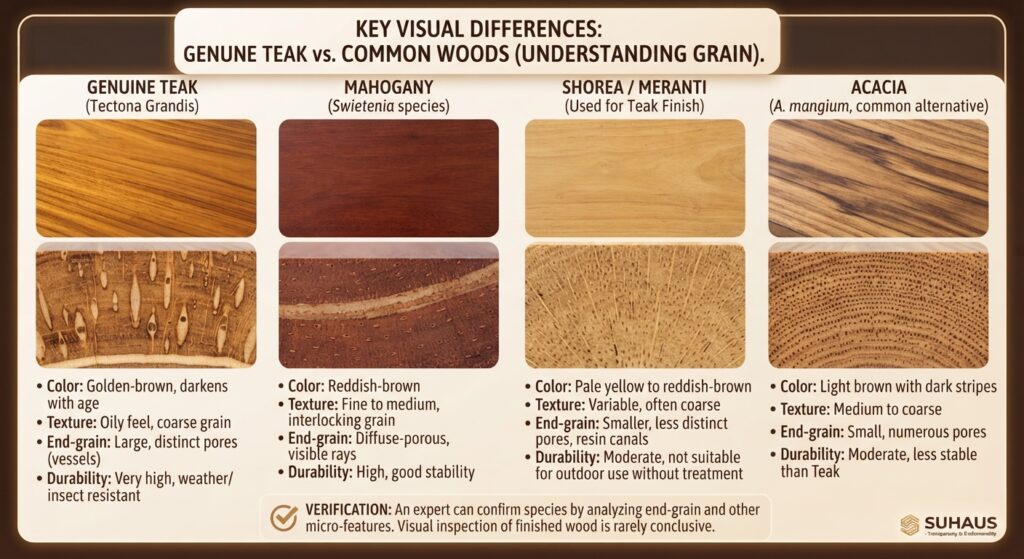
To some extent, grain patterns can help identify wood. Different species often have characteristic grain structures, colours, pores and other features.
However, there is a difference between recognising a possible clue and confidently identifying a species.
Several factors can complicate visual identification:
• Different species can have similar looking grain patterns.
• Staining can change the appearance of the grain.
• Polishing can emphasise some features while making others less obvious.
• Natural variation means that pieces of the same species do not all look identical.
• Veneer and other wood based materials can introduce additional visual patterns that do not necessarily reveal the underlying construction.
This is why confidently identifying a wood species from a finished furniture photograph is often unrealistic.
If the distinction matters to your purchase, it is better to ask for material specifications and inspect the wood before finishing, where possible. Visual inspection can support verification, but it should not be treated as a substitute for it.
4. What about weight, hardness and smell?
Buyers sometimes try to identify wood by lifting a piece of furniture, pressing a fingernail against the surface or smelling the wood.
These observations may provide clues, but none is conclusive on its own.
Weight
Heavier furniture is not necessarily made from teak or even from a more suitable wood. Overall weight depends on the dimensions, construction, other materials and the species used.
Hardness
A surface that feels hard does not establish the species. Finishing treatments can influence the surface feel, and different species have overlapping physical characteristics.
Smell
Some woods have distinctive odours when freshly cut, but these may become less noticeable after drying and finishing. Smell is not a dependable way to verify the species of finished furniture.
These checks are not entirely useless. They simply have limits.
The mistake is treating one characteristic as definitive proof. A better approach is to combine clear material specifications, appropriate inspection and a manufacturer’s willingness to explain what has been used.
5. So how can you actually verify what wood is being used?
If you are buying a substantial piece of furniture, there are several practical steps you can take.
Ask for the exact wood species
Start by asking what species is being used for the structural frame or other specific component you are buying.
Avoid accepting broad answers such as “good quality wood” or “premium solid wood”. Ask for the actual species.
If different materials are used in different components, ask for that distinction to be made clear.
For example, the main frame, decorative panels and internal supports do not necessarily have to use identical materials. What matters is understanding what has been specified for each relevant part.
Ask whether you can see an unfinished sample
An unfinished piece of wood often reveals more of its natural grain and colour than a polished piece.
This can make inspection easier, although visual identification may still require experience. A sample should also correspond to the material being proposed for your furniture rather than being an unrelated display piece.
If you are comparing quotations, ask each seller to specify the wood species in writing. That gives you something concrete to compare instead of relying on descriptions such as “teak look” or “solid wood quality”.
Ask to see the wood in the actual furniture
This is particularly useful when you are ordering custom furniture from trusted custom furniture makers bangalore. A sample tells you what a manufacturer can use. Seeing the material in your own furniture during production helps you understand what is actually going into your order.
At Suhaus, customers can visit the factory and see their own furniture while it is being made. Before upholstery and finishing cover the frame, they have an opportunity to see the wooden structure and ask questions about its construction. This is an important distinction from buying a finished, ready made sofa or cot where the internal structure may already be hidden.
It does not mean that every ready made furniture seller is untrustworthy, or that visiting a factory automatically proves every material claim. It means that being able to inspect your own furniture during production provides an additional opportunity for transparency.
Get the material specification documented
For a significant purchase, ask for the promised wood species to be recorded in the quotation, order confirmation or another appropriate written document.
The description should be specific enough to avoid confusion between the actual wood and its finish. If the manufacturer cannot clearly explain what has been used, or the written description differs from what was discussed, resolve that before making the purchase.
6. Why seeing the actual frame matters
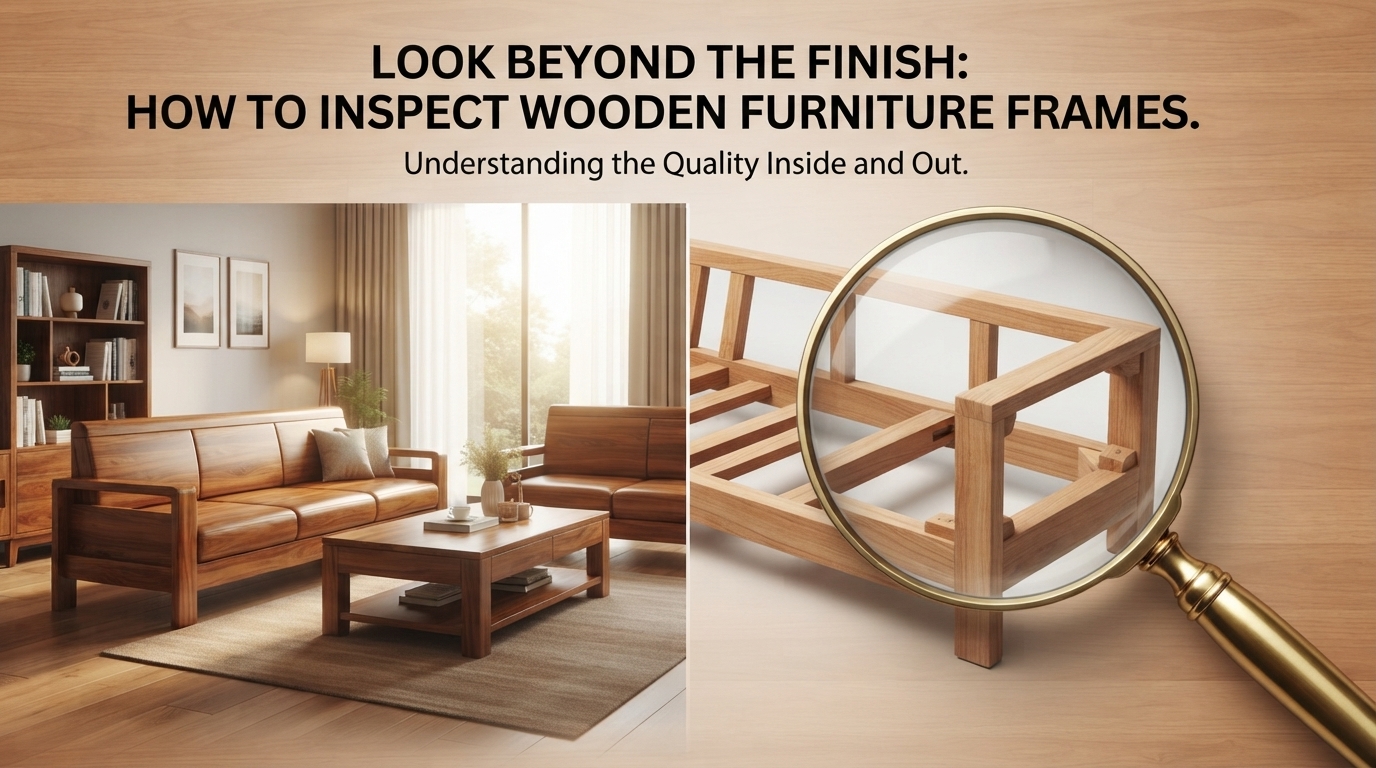
The frame is particularly important when buying a wooden sofa because much of it will eventually be hidden beneath cushioning and upholstery. Many buyers overlook what is inside a sofa when evaluating exterior appearances. To explore this further, you can read our insights on how to know what is inside a sofa before you buy it.
Once the sofa is finished, you may be able to see the exposed wooden legs or decorative arms, but these do not necessarily tell you what is used throughout the structural frame.
A sofa could have visible wooden sections that look attractive while other structural components use different materials. That is not automatically a problem, provided the construction is suitable and the materials are accurately represented. The issue is whether you understand what you are buying.
At Suhaus, we believe customers should have the opportunity to see the construction of their own furniture while it is being made. They can inspect the frame, see the wood being used and ask about the structural members and reinforcement before these components are covered.
This is useful for two reasons. First, it makes the manufacturing process easier to understand. Second, it allows questions to be raised at a stage when the construction is still visible. Transparency is not just telling a customer what materials are being used. It is creating opportunities for them to understand and inspect the product they are paying for. That principle is relevant whether you are buying a wooden sofa, cot, dining table or another piece of furniture.
7. Does choosing teak automatically mean you are buying better furniture?
Not necessarily.
Teak is valued for properties that can make it suitable for furniture, but the wood species is only one part of the decision.
The suitability of any wood depends on the intended application, its condition and preparation, the construction of the furniture and how the finished product will be used and maintained.
Even furniture made from the same species can differ substantially in its construction and workmanship.
A well designed piece made from a suitable alternative may be a more sensible purchase for a particular budget or application than poorly constructed furniture made from teak.
Likewise, if you are specifically paying for teak, it is reasonable to expect the material claim to be accurate.
The point is not to dismiss the importance of wood species. It is to avoid treating the name of a species as a complete measure of furniture quality.
Things People Often Overlook
The wood used for visible parts may not tell the whole story
The exposed arms or legs of a sofa are not necessarily representative of every part of its structural frame. Ask about the components that matter to the construction, not only the pieces you can see after delivery.
A polished sample may not be enough
A finished sample is useful for judging appearance, but it can make the underlying material harder to inspect. Ask whether an unfinished sample or a view of the actual frame during manufacturing is available.
A written promise is useful, but specificity matters
A document that says “solid wood” may still leave important questions unanswered. If a particular species is important to your decision, ask for that species to be named explicitly.
Do not assume that a different wood automatically means poor quality
Different species have different properties and applications. The issue is whether the material is appropriate for the product and whether it matches what the seller has promised.
A Practical Checklist Before You Check Wood Before Buying Furniture
| What to check | What to do |
| Actual wood species | Ask for the specific species, not just the colour or finish |
| Different components | Clarify whether the same material is used throughout the relevant structure |
| Unfinished wood | Ask whether you can inspect an unfinished sample |
| Actual construction | If ordering customized home furniture, ask whether you can see your own frame during production |
| Written specification | Have the promised material recorded in the order documentation |
| Seller’s explanation | Check whether the seller can clearly explain the materials and construction |
| Price comparison | Compare quotations only after confirming that the material specifications are genuinely comparable |
You do not need to become a wood identification expert to buy furniture more confidently. You just need to address key furniture buying questions (for more guidance, review our checklist on before you buy furniture, ask these 10 questions) and know what evidence helps answer them, whether you are dealing with independent artisans or established furniture manufacturers in bangalore.
The Takeaway
Once wood has been polished, stained or finished, identifying the actual species can become difficult. Colour, grain, weight and surface feel may offer clues, but none should be relied on as definitive proof.
If a particular wood species matters to your purchase, ask what is being used, have the material specified clearly and look for opportunities to inspect the wood before finishing. For custom furniture, being able to see your own frame during manufacturing provides an additional level of visibility that you may not have when buying a fully finished product.
Do not buy wood based on what it looks like alone. Understand what it is, where it is being used and how you can verify the claim. That is a more reliable way to make an informed furniture purchase. For deeper insight into general craftsmanship, feel free to browse our article on what makes durable furniture and the parts you cannot see.
Questions We Get Asked Often
1. Can you identify teak wood after it has been polished?
Sometimes an experienced person may recognise useful visual characteristics, but a polished surface can make identification difficult. Colour and grain alone should not be treated as conclusive proof of the species.
2. Does teak finish mean the furniture is made from teak?
No. Teak finish generally describes an appearance. Ask whether the actual wood is teak and request a clear material specification.
3. Is solid wood always better than engineered wood?
Not in every application. When planning your investment in custom made furniture bangalore, the appropriate material depends on the product, intended use, construction, environmental conditions and budget. First understand what the furniture is designed to do, then compare suitable materials.
4. How can I check whether a wooden cot is really made from teak?
Ask for the species to be specified in writing, request an unfinished sample if available and ask whether the relevant components can be inspected before finishing. If there is a material dispute, visual inspection alone may not settle it, and independent expert assessment may be necessary.
5. Can a furniture manufacturer use different woods in the same sofa?
Yes, different components may use different materials depending on the design and their function. The important considerations are whether the materials are suitable, whether the construction is sound and whether the manufacturer’s description accurately represents what is being supplied.
6. Is buying directly from a manufacturer enough to guarantee the wood is genuine?
No. Buying directly can make it easier to ask questions and understand the manufacturing process, but it is not proof by itself. Clear specifications, appropriate inspection and transparent communication still matter.