How to Choose the Perfect Wooden Study Table for Your Home
A wooden study table looks like a fairly simple piece of furniture. A flat surface, four legs, perhaps a drawer or two, and you are done. But anyone who has spent several hours working or studying at an uncomfortable table knows that the details matter.
A table that is too high can make your shoulders uncomfortable. One that is too shallow may not give you enough room for a laptop and books. A table with lots of storage can look useful in a catalogue but become awkward when you actually need legroom.
And when you are buying a wooden study table for a child, student or adult, the right choice can be quite different. To see how desks fit into overall room planning, take a look at our guide on what types of living room furniture are commonly used. So instead of choosing a study table purely because you like its design, it is worth looking at how you will actually use it.
Start With Who Will Use the Study Table
The first question is surprisingly simple: Who is going to sit at it every day?
A table for a young child does not necessarily need the same proportions as a wooden study table for students preparing for exams or an adult working from home.
Think about:
• The person’s height
• Whether they use a laptop or desktop
• How many books they normally keep on the table
• Whether writing and reading are the main activities
• Whether the table needs storage
• How many hours they will spend there each day
A table used for occasional homework has very different requirements from one used for six or eight hours of work every day.
1. Get the Height Right
The height of the table affects how comfortably you can sit and work.
If the table is too high, you may find yourself raising your shoulders or lifting your arms unnaturally. If it is too low, you may end up leaning forward more than you should.
The table should work together with the chair. This is important because people sometimes buy the study table first and then try to find a chair that works with it. Ideally, think about both together.
For children, this becomes even more important because their height changes over time. A wooden study table for kids that works well today may not be equally comfortable after a few years unless paired with adjustable seating or tailored dimensions.
2. Think About the Table Depth, Not Just Its Width
When people look at furniture online, width is usually the first measurement they notice. Depth is just as important.
A student may need space for:
Laptop + notebook + textbooks + stationery
An adult working from home might need:
Laptop + monitor + keyboard + notebook
A narrow table may technically fit into the room but leave everything competing for the same small surface. On the other hand, an unnecessarily deep table can take up valuable floor space. The right depth depends on what you actually keep on the table.
3. Decide How Much Storage You Really Need
Study tables can come with drawers, shelves, cabinets, open compartments and combinations of all of these. More storage is not automatically better.
If you mainly use a laptop and a notebook, several large drawers may simply take away legroom. If you are a student with textbooks, stationery, files and other materials, additional storage may be genuinely useful.
A simple way to decide is to make a list of what you want to keep close to the table. Then choose storage around that list rather than buying a table with every possible compartment.
| Your usage | Storage that may make sense |
| Occasional laptop use | Minimal storage |
| School student | Drawers or accessible shelves |
| College student | Combination of drawers and open storage |
| Work from home | Cable management plus selected storage |
| Heavy paperwork | Larger drawers or nearby storage |
4. Leave Enough Legroom
This is one of the easiest things to overlook when buying a study table.
A table can look beautiful from the front while having very little usable space underneath. Drawers and cabinets positioned directly where your knees need to go can make a table uncomfortable.
Before buying, look underneath the table and ask:
Where will my knees go?
Can I move my legs comfortably?
Will the chair actually fit inside the table?
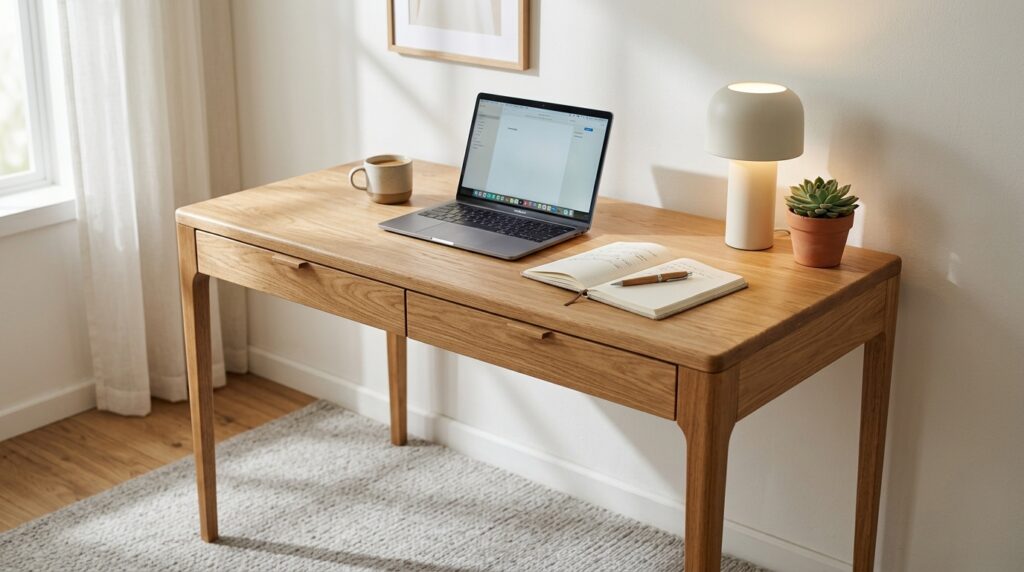
This becomes particularly important when choosing a study table with drawers or side cabinets.
5. Choose the Wood Carefully
If you specifically want a wooden study table, do not stop at the phrase itself. Ask what wood is actually being used.
Different types of wood have different characteristics, and the construction of the table matters just as much as the species. For a complete guide on material selection, read our buyer’s guide on what are the best woods for making wooden furniture in india.
A useful conversation with the seller should cover:
• The actual wood species
• Whether the main structure is solid wood
• Whether plywood or other materials are used in specific components (see our comparison on solid wood vs veneer vs engineered wood)
• How the joints are constructed
• What finish is being applied and how to maintain it (check how to prevent cracking in wood furniture)
• How the table is expected to be maintained
A polished wooden surface can also make it difficult for a buyer to understand exactly what is underneath. The appearance of the finish should not be treated as proof of the underlying material.
This is a point worth checking before making a higher value furniture purchase.
6. Do Not Choose the Table Only for Its Design
There are plenty of attractive wooden study table designs available today.
Minimal tables.
Tables with drawers.
Tables with open shelves.
Tables with cabinets.
Floating study tables.
Traditional wooden desks.
Modern designs with clean lines.
The design matters, but it should come after the practical requirements.
For example, a very minimal table may look excellent in a photograph but provide nowhere to store books. A large traditional desk may provide excellent storage but overwhelm a small bedroom. The best design is usually the one that fits both the room and the way you work.
7. Consider the Room Before Choosing the Table
Measure the space where the study table will actually go. But do not measure only the empty wall. Also consider:
Chair space
Door opening
Windows
Wardrobe doors
Electrical sockets
Walking paths
Natural light
A table may fit perfectly against a wall but become inconvenient once the chair is pulled out. If the table is going into a bedroom, make sure it does not interfere with the main circulation path. For smaller homes, this becomes particularly important because one piece of furniture can affect the usability of the entire room.
Check out our guide on space-saving furniture options for small apartments in bangalore to optimize tight bedroom or study corners.
8. Think About Natural Light
Where you place the table can affect how pleasant it is to use.
Natural light can make a study area more comfortable during the day, but you should also consider glare. For someone using a laptop regularly, direct sunlight falling onto the screen can be irritating.
Think about where the light comes from and how it changes during the day. Sometimes moving a study table slightly away from the window can make the space more comfortable than placing it directly beside it.
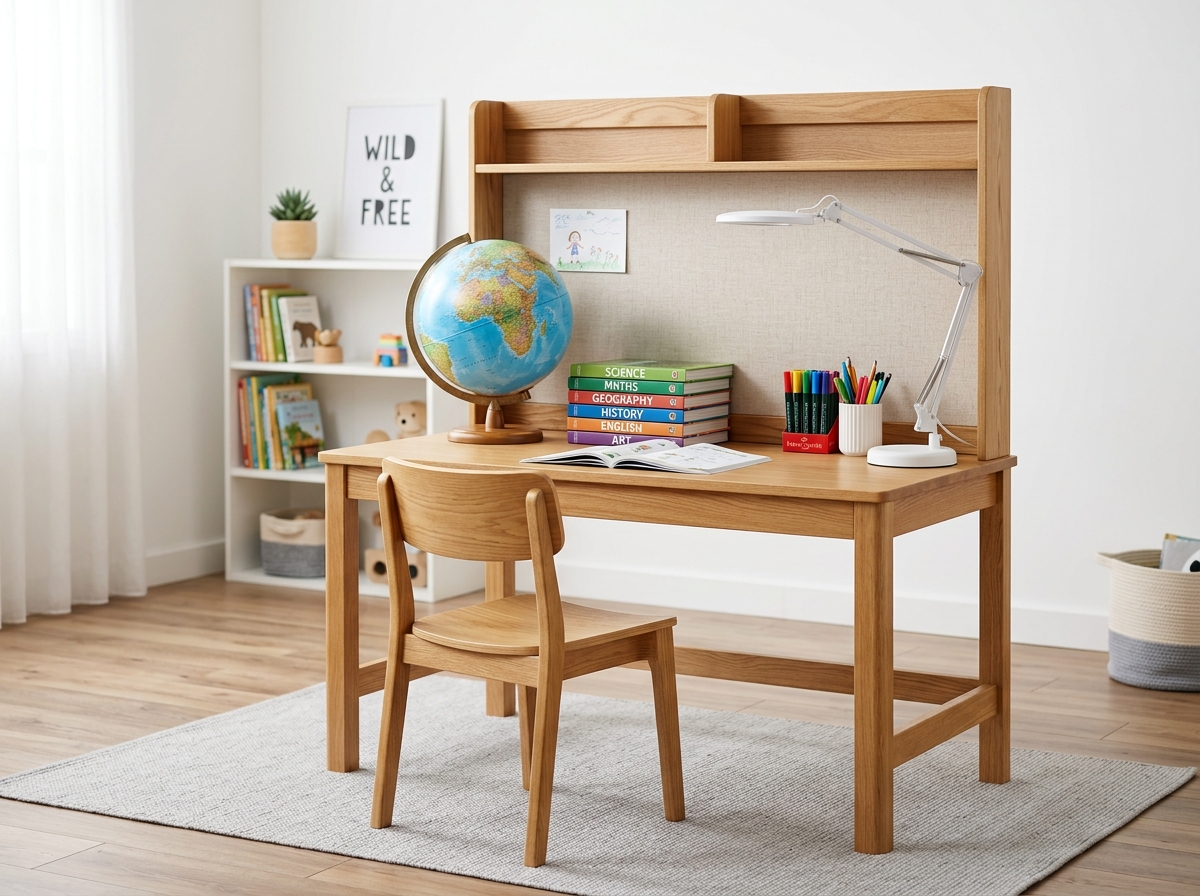
9. What Should You Look for in a Study Table for Kids?
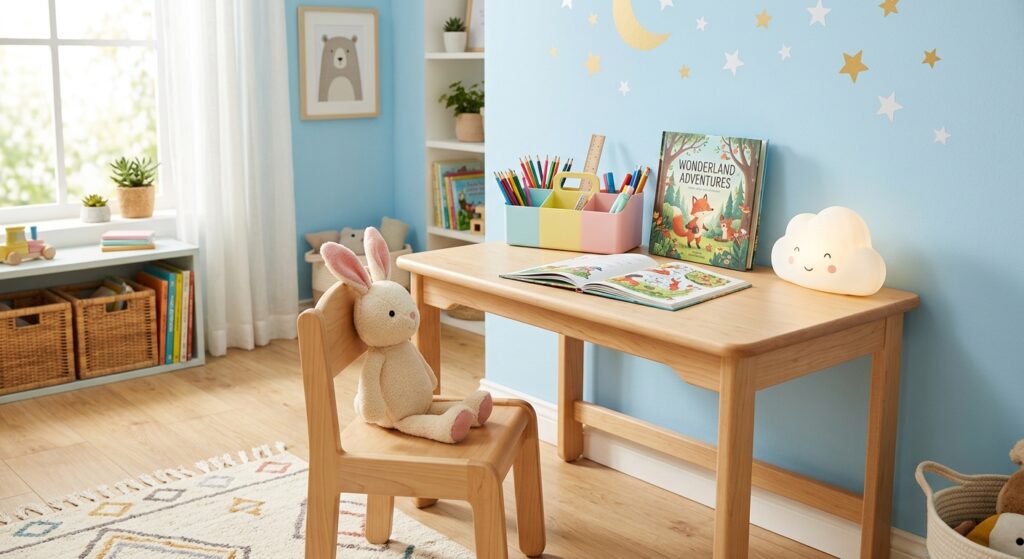
A wooden study table for kids needs a little more thought because the user is still growing.
Instead of choosing a table purely because it looks like a children’s product, consider how long it will realistically remain useful.
Look for:
• A comfortable working height
• Enough surface area for schoolwork
• Rounded or properly finished edges
• Stable construction
• Useful storage without sacrificing legroom
• A design that can continue to work as the child grows
The last point is often overlooked. A highly themed children’s study table may look appealing today but may not suit the child a few years later. A simple wooden study table can sometimes have a much longer useful life.
10. What About a Study Table for Students?
A wooden study table for students often needs to accommodate more than just a place to put a laptop. Depending on the course, the table may need to hold books, notebooks, stationery, drawings, documents or other materials.
For this reason, surface area becomes particularly important. A student studying architecture, for example, may need considerably more working space than someone whose work is almost entirely laptop based. The table should reflect the work rather than simply the title of the user.
11. When Does a Custom Wooden Study Table Make Sense?
A custom wooden study table is not automatically better than a ready made one. If you find a standard table that fits your room, suits your height and provides everything you need, there is little reason to complicate the purchase. Customisation becomes more useful when the room has a specific constraint.
For example:
• An unusually narrow wall
• A corner that needs to be used efficiently
• A requirement for specific storage
• A particular height requirement
• A need to accommodate multiple devices
• A study table that needs to fit around existing furniture
This is where custom furniture can solve an actual problem rather than simply offering more design choices.
Ready Made or Custom Wooden Study Table?
| Factor | Ready made | Custom |
| Price | Often simpler to compare | Depends on materials and specification |
| Size | Limited to available dimensions | Can be made around the room |
| Storage | Fixed configuration | Can be designed around your needs |
| Design | Choose from existing options | More flexibility |
| Delivery | Usually simpler | Requires manufacturing time |
| Unusual spaces | May not fit efficiently | Better suited |
| Replacement | Easier to find similar models | Specific to the original design |
At Suhaus, an established customized furniture manufacturer in bangalore, bespoke furniture solves exact functional needs. Whether you are looking for custom study desks or matching bedroom joinery, partnering with skilled custom furniture makers bangalore homeowners trust ensures your workspace is tailored to your exact height and floor plan. .
What Makes a Wooden Study Table Good for Everyday Use?
A good study table does not need complicated features. It needs to do its basic job well.
The surface should be stable. The table should not wobble when you write or type. The height should work with your chair. The drawers should open properly. The edges and finish should be properly done.
And perhaps most importantly, the table should still feel comfortable after you have been sitting there for a couple of hours. That is a better test than whether it looks impressive for five minutes in a showroom.
A Simple Checklist Before You Buy
Before ordering a wooden study table, ask yourself:
Space
☐ Have I measured the available wall and floor space?
☐ Is there enough room for the chair?
☐ Will doors, windows or wardrobes interfere?
Usage
☐ Who will use the table?
☐ How many hours will they use it?
☐ Laptop, desktop or mainly books?
☐ How much surface area is actually required?
Construction
☐ What wood is being used?
☐ What materials are used in the different parts?
☐ Does the table feel stable?
☐ Are the joints and drawers properly constructed?
Comfort
☐ Is the height suitable?
☐ Is there enough legroom?
☐ Does the chair fit comfortably?
Storage
☐ What actually needs to be stored?
☐ Are drawers more useful than open shelves?
☐ Is storage taking away too much legroom?
The Takeaway
Choosing a wooden study table is less about finding the most attractive design and more about finding the right relationship between the person, the work and the room. Start with how the table will actually be used.
Then consider its height, depth, storage, legroom, construction, wood and finish. Only after that should you worry about whether you prefer a particular wooden study table design. And if standard furniture does not fit your room or requirements properly, a custom wooden study table can be a practical solution rather than simply a more expensive option. The best study table is ultimately the one that makes it easier to sit down and work comfortably every day.
Questions People Often Ask
1. Which wood is best for a wooden study table?
There is no single answer that applies to every table. The wood species, construction, dimensions, usage and finish all matter. It is more useful to ask what wood is being used and whether it is appropriate for the intended use than to choose purely based on a species name.
2. What size should a study table be?
The right size depends on the user and what they need to keep on the table. A laptop only requires less surface area than a setup involving a monitor, books and paperwork. Measure the room and then work backwards from actual usage.
3. Is a wooden study table good for kids?
Yes, provided the proportions and height are appropriate for the child. It is also worth considering how long the table will remain useful as the child grows.
4. Should I buy a study table with drawers?
Only if you need them. Drawers are useful for stationery, books and other items, but excessive storage can reduce legroom and make the table unnecessarily bulky.
5. Is a custom wooden study table worth it?
It can be worthwhile when you have unusual room dimensions, specific storage requirements or particular ergonomic needs. If a ready made table already fits your requirements, customisation may not add enough value to justify the extra time and cost.