What Happens When Your Furniture Needs Repair or Service?
Buying furniture is the easy part. Finding someone to fix it a few years later can be a very different experience.
A sofa starts sagging. A recliner stops operating properly. A dining chair becomes loose, or the upholstery begins peeling before you expected it to. You contact the seller, only to discover that servicing is not straightforward, spare parts are unavailable, or nobody seems quite sure who is responsible. When your furniture needs repair or service, knowing your options can help you decide what to do next.
These situations raise an important question that buyers often overlook: what happens to your furniture when it needs attention after the purchase?
Not every problem means the furniture is poorly made, and not every issue requires replacing the entire piece. Understanding the problem, the construction and the repair options can help you make a more sensible decision. Before making a major purchase, review our guide on 10 essential questions to ask before buying furniture.
1. First, Understand What Has Actually Gone Wrong
Before you arrange a repair or consider replacing the furniture, identify the problem as clearly as possible.
Furniture has several components, and different problems require different solutions. A loose joint is not the same as a broken frame. A sagging cushion may need different attention from a damaged suspension system.
| Problem | What might be causing it | What to investigate |
| Sofa feels saggy | Cushion compression, suspension issues or structural damage | Whether the problem is limited to the cushions or affects the supporting structure |
| Chair wobbles | Loose joints, fasteners or damaged components | Whether the joints can be tightened or need repair |
| Upholstery is peeling | Material deterioration, surface damage or wear | Whether the affected covering can be replaced and what lies underneath |
| Recliner stops working | Mechanical, electrical or control component issue | The mechanism type, availability of parts and repair options |
| Wooden furniture develops cracks | Moisture movement, environmental changes or material related issues | The size, location and progression of the crack |
| Drawers or doors stop working smoothly | Hardware problems, alignment changes or wear | Whether adjustment or hardware replacement is sufficient |
These are possible causes, not diagnoses. A photograph or a short description may help identify the likely issue, but some problems require an in person inspection.
Expert tip: Describe what has changed, when you first noticed it and whether it is getting worse. This is more useful to a repair professional than simply saying the furniture is damaged.
2. Can the Furniture Be Repaired, or Does It Need Replacing?
Assess the damage, check the remaining components and compare repair costs before deciding.
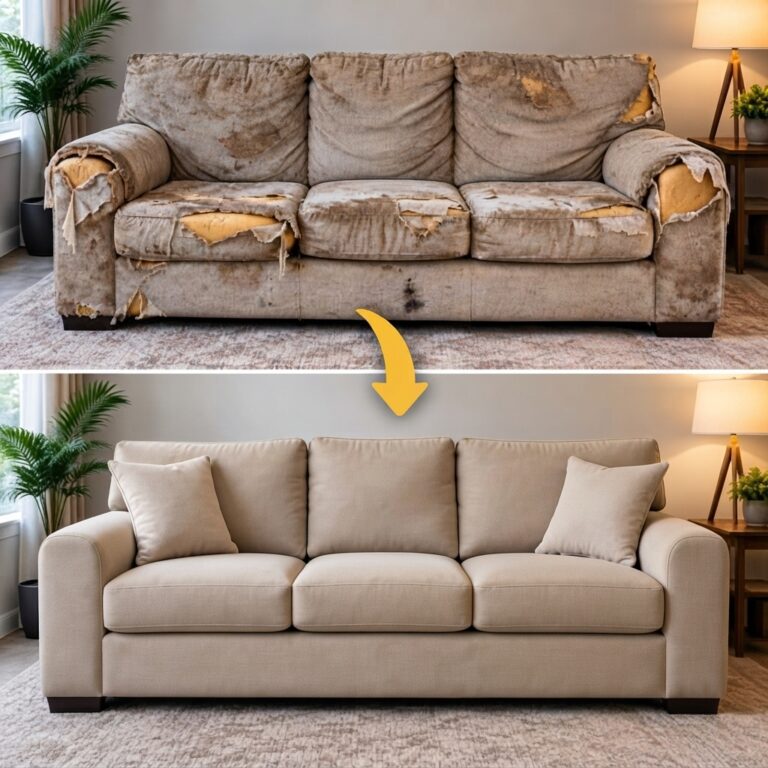
For example, a sofa with worn upholstery may still have a usable frame. Replacing the covering could make sense if the structure and seating support are in good condition. If you are assessing upholstery wear, read our breakdown on why sofa fabric peels, sags or wears out quickly.
On the other hand, replacing fabric will not solve a seriously damaged frame. Similarly, fitting a new cushion will not necessarily fix a problem caused by the suspension underneath it.
Before deciding, assess the furniture as a whole.
| Situation | What may make sense |
| Localised upholstery damage | Repair the affected area or replace the covering, depending on the material and extent of damage |
| Flattened or uncomfortable cushions | Assess whether the cushioning can be replaced without rebuilding the sofa |
| Loose wooden joints | Have the joints inspected and repaired if the structure remains suitable |
| Damaged frame | Obtain an assessment of the extent of the damage and the feasibility of structural repair |
| Faulty recliner mechanism | Check whether compatible replacement parts and servicing are available |
| Multiple major failures | Compare the full repair cost with the cost and expected usefulness of a replacement |
Do not compare repair costs with the original purchase price alone. The original amount is already spent. What matters now is the cost of restoring the furniture to a condition you are happy to use, compared with the cost and benefits of replacing it.
A repair that costs more than you expected may still be worthwhile if it restores a well suited piece of furniture. A cheap repair may be poor value if the underlying problem remains unresolved. To evaluate pricing value accurately, review our guide on how to compare furniture prices without comparing only the price.

3. Why Some Furniture Is Easier to Repair Than Others
Buyers sometimes discover a gap between purchasing furniture and maintaining it. When a problem arises, understanding your support options helps you decide what to do next.
Construction methods, assembly techniques and replacement-part availability often determine how easily you can repair furniture.
Consider a recliner. If the mechanism fails, the repair professional needs to identify the mechanism, determine what has gone wrong and establish whether a compatible component can be sourced. If the original supplier cannot identify the mechanism or provide parts, repair may become more complicated.If you are choosing between mechanism types, see our comparison of manual vs electric recliner sofa options.
The same principle applies to sofas, beds, dining furniture and storage units.
Before buying furniture, it is worth asking:
• Can the upholstery or cushioning be replaced independently?
• Are the major structural components accessible for inspection and repair?
• Does the product use identifiable mechanisms or hardware?
• Can compatible replacement parts be sourced if something fails?
• Does the seller provide repair support, or will you need to find an independent professional?
You may not need every answer for a simple side table. But for a costly sofa, recliner or frequently used piece of furniture, these questions can influence how practical it is to own the product over time.
4. What If the Original Seller Does Not Offer Repairs?
This is where buyers can discover an uncomfortable gap between purchasing furniture and maintaining it.When your furniture needs repair or service, understanding the available support options can help you decide how to proceed.
Some sellers offer ongoing service. Others may direct customers to an independent carpenter, upholsterer or specialist repair professional. Neither arrangement automatically makes the furniture good or bad, but you should understand what support is actually available.
If the original seller cannot help, consider these options:
Contact an independent repair professional.
A carpenter may be suitable for certain wooden furniture problems, while an upholsterer may be better placed to assess damaged fabric or cushions. Recliners and specialised mechanisms may require someone with relevant experience.
Ask for an assessment before authorising work.
Understand the likely cause, the proposed repair, the expected cost and any limitations. If the problem could affect structural safety, avoid continued use until it has been assessed.
Compare repair and replacement.
If the damage is extensive or the necessary parts are unavailable, a replacement may be more practical. Make the decision based on the condition of the furniture and the expected outcome, not frustration alone.
Check whether the issue falls under an existing warranty or agreement.
If it does, contact the seller before commissioning outside repairs, as the terms may affect your options.
Be cautious about approving a repair before you understand what it will address. A professional should be able to explain the proposed work in terms you can follow, even if the technical details are unfamiliar.
5. Does a Warranty Mean You Will Get Good Service?
A warranty and a practical repair service are related, but they are not the same thing. Understanding your furniture warranty, including its coverage and exclusions, can help you know what support to expect when a problem occurs.
A warranty explains which problems the seller or manufacturer will cover under specific conditions.
For instance, a warranty may cover certain components but exclude ordinary wear, accidental damage or other issues. The process may require photographs, an inspection or proof of purchase. Some products may also require specialised parts.
Before relying on a warranty, understand:
• What is covered and for how long.
• Which parts or types of damage are excluded.
• How to report a problem and what evidence is required.
• Whether an inspection, repair or replacement is the expected remedy.
• Whether servicing or transport charges may apply.
• Whether the seller can realistically support the product if it needs attention.
A long warranty period is not, by itself, proof that the product will be trouble free. Equally, the practical usefulness of a shorter warranty depends on its terms and the support available.
The important question is not just how long the warranty lasts. It is whether you understand what it offers and how to use it.
6. Can Custom Furniture Be Easier to Repair?
It can be, depending on how the furniture was designed and made.
Custom furniture is not automatically more repairable than ready made furniture. The advantage comes when the construction is understandable, the components are accessible and the maker can identify what went into the particular piece.
For example, if a customized sofa in Bangalore was made to specific dimensions and comfort preferences, replacing a cushion or upholstery may be preferable to finding an entirely new sofa that fits the same space and suits the same needs.Read our guide on custom wooden sofa design vs ready-made to see how custom construction compares with ready-made alternatives.
A maker who knows the original construction may also be better placed to assess what needs attention. However, this depends on whether the maker retains relevant information, continues to offer support and can source the necessary materials or components.
When discussing custom home furniture with a furniture manufacturing company in bangalore, ask whether the maker can help with future repairs and what that support includes. Do not assume that custom made automatically means lifetime servicing.
At Suhaus,a leading customized home furniture manufacturer in bangalore, customers can discuss the construction of their furniture directly with the team and visit the factory to see their own pieces during production. Knowing how a piece is assembled can provide useful context if a repair is needed later.To understand what structural elements to inspect during a visit, see how to know what is inside a sofa before you buy it.
7. What Should You Do When a Problem First Appears?
Ignoring small problems or attempting unsuitable repairs can make the damage worse.
A sensible first response is straightforward.
Step 1: Document the problem. Take clear photographs or a short video. Note when the issue began and whether it affects normal use.
Step 2: Check your purchase documents. Look at the order details, warranty terms and any service commitments.
Step 3: Contact the seller or manufacturer. Explain the issue clearly and ask for an assessment or the recommended next step.
Step 4: Avoid making the damage worse. Do not force a stuck mechanism, continue using unstable furniture or attempt structural repairs without suitable knowledge.
Step 5: Get the proposed repair explained. Ask what will be repaired, what will remain unchanged, how much it will cost and whether there are any limitations.
Step 6: Keep a record. Save the communication, quotation and details of the repair carried out.
If the issue appears to involve a manufacturing defect or a commitment the seller has not honoured, raise that clearly before paying for independent work. Your options will depend on the circumstances and the applicable terms.
Common Mistakes to Avoid
Replacing furniture before checking whether it can be repaired. Worn upholstery or cushions do not necessarily mean the entire piece has reached the end of its useful life.
Repairing the visible symptom instead of the underlying problem. New upholstery will not fix a damaged frame, and new cushions may not resolve a suspension problem.
Assuming every carpenter can repair every product. Wooden joints, upholstery and powered mechanisms require different skills.
Choosing the cheapest repair without understanding its scope. A partial fix may leave the underlying problem untouched.
Waiting until the furniture becomes unusable. Early assessment may reveal a simpler solution, although not every developing problem can be prevented.
Assuming the seller will always have spare parts. Ask about service arrangements and component availability rather than relying on assumptions.

The Takeaway
Furniture does not become disposable the moment something goes wrong. Many problems can be assessed, and some can be repaired without replacing the entire piece.
The challenge is understanding what has failed, whether the repair is practical and who can carry it out properly.
Before buying, look beyond the product’s appearance and price. Consider how it is constructed, whether important components can be replaced and what support is available after delivery.
Good furniture ownership is not just about how a piece looks when it arrives. It is also about what you can do when it eventually needs attention.
Questions We Often Hear
1.Is it worth repairing an old sofa?
It depends on the frame, cushioning, upholstery, repair cost and how well the sofa suits your needs. If the structure is sound and the problem is limited to replaceable components, repair may be worthwhile. If several major components need attention, compare the full repair cost with replacement.
2.Can sofa cushions be replaced without replacing the entire sofa?
Often, yes. If the frame and supporting structure are in good condition, the cushions may be replaceable. The feasibility depends on the sofa design, cushion construction and availability of suitable replacement materials.
3.What should I do if my recliner stops working?
Stop using it if the mechanism is jammed, unstable or potentially unsafe. Check the product instructions and contact the seller or a repair professional familiar with that type of mechanism. Ask whether the faulty component can be repaired or replaced and whether compatible parts are available.
4.Can I repair furniture that is no longer under warranty?
Yes, depending on the problem and whether a suitable repair professional or replacement component is available. An expired warranty does not automatically mean the furniture cannot be repaired. Obtain an assessment before deciding whether to repair or replace it.
5.Should I buy furniture from a seller who does not provide after sales service?
That depends on the product, price, expected lifespan and availability of independent repair services. For a simple, inexpensive piece, you may be comfortable arranging repairs independently. For a costly sofa or a complex recliner, limited support may be a significant disadvantage.